EDDIE0:00how do you think about specifically the number of accounts to give an SDR or an 80 that's doing an outbound or following up on the inbound, what have you?
JAMES0:07capacity on inbound, especially hot inbound should be a math equation demos per day. That's the metric that we use
JAMES0:14shouldn't be a lot of guesswork
JAMES0:16Outbound is a little bit more challenging.
EDDIE0:18you said inbound, and then you describe somebody raising their hand, going filling out a form, basically saying, I want to talk to sales.
EDDIE0:23are you only thinking of those sort of hot
EDDIE0:26hand razor leads, or are you also including the so-called leads, the folks filling out forms?
EDDIE0:31Download whitepapers,
EDDIE0:32that end up, you know, being identified as an mql in many organizations?
JAMES0:36delineate hot versus warm on inbound.
JAMES0:39hottest lead, if you will, to your point is a form filled. They've requested a demo. They've done the CTA, the call to action
JAMES0:46where they get to your website. There is a call to action speak with someone. It doesn't get any hotter than that.
EDDIE0:52you've got to spend money from your precious budget to have your salespeople following up with these
EDDIE0:57mql just like you do outbound. So how do you think about
EDDIE0:59that problem.
JAMES1:00So, Eddie,
JAMES1:01we've only got an hour and you just hit on probably
JAMES1:04one of the hottest topics
EDDIE1:10Welcome to go to Market Science, the podcast for crows and revenue leaders scaling mature B2B companies.
EDDIE1:15There's an art and there's a science to go to market and we're obsessed with the science.
EDDIE1:19In this podcast, we share tangible, actionable playbooks from the trenches,
EDDIE1:23what we're learning, working as go to market strategy and DevOps consultants for our clients here at Union Square, Consulting
EDDIE1:29and candid conversations with revenue leaders in the market that have been there.
EDDIE1:32If this podcast delivers value, we'd love a five star rating and a follow. Now let's get into it.
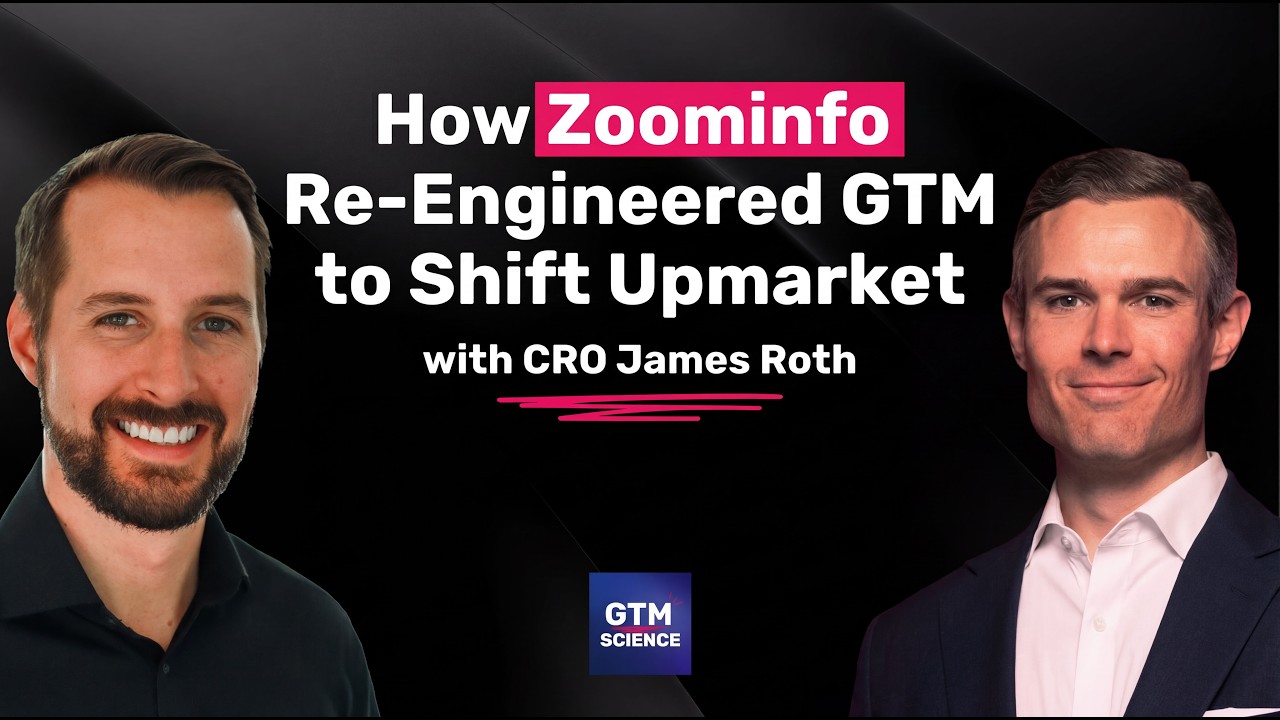
EDDIE1:41Welcome to another episode of Go to Market Science. I'm Eddie Reynolds, the founder and CEO of Union Square Consulting. And today we're going to talk about how zoom info re-engineered their go to market to shift focus from inbound SMB to more outbound and up market. And we have our special guest today, James Ross, the Chro of Zoom Info.
EDDIE2:00Thank you for joining me today, James.
JAMES2:01Hey, Eddie, thanks for having me.
EDDIE2:03I'm very excited to dive into this topic. We've talked offline a lot about what we wanted to cover today, and I think this is going to be a really valuable episode for folks in Go to Market that are thinking about their inbound motion or outbound motion, how they compare the two, how they invest in either or both. And, I'm just really excited to dive into it.
EDDIE2:22So we wanted specifically to discuss how
EDDIE2:24you shifted from about 5050 SMB up market to about 7327 up market SMB and rebuilt your outbound motion. Also want to talk about the financial and the operational reasons behind the decisions to shift focus. So you know, like I said thanks for joining us today. Let's start by just asking you, can you describe the shift in focus maybe very high level.
EDDIE2:46What was the before and what was the after picture of the latest iteration that you can share? Not asking you to forecast the future of course.
JAMES2:53Yeah. So happy. Happy to dive in. Thanks again for having me. You know, I think a lot of companies through serve through stay at home through Covid. It's a great time to be in B2B, SAS and I think a lot of companies took advantage of the fact that there was a ton of free money floating around, and SMB was a great place to be.
JAMES3:16Now, there are many companies that service almost all SMEs that are amazing companies. So don't get me wrong, it's it's a great space to be at least what we saw in our particular space is that, you know, that SMB 2021, 2022 that like I said, surf. There was all sorts of money floating around it. It just became a more challenging place.
JAMES3:38And I think in general, you know, whether it's customers that are in business then go out of business, you know, traditionally, like the micro SMB, which we constitute a 0 to 10 employees, if you think back to 2021, where anyone could go be a startup and they could raise money and they paid no interest on that money, it was a great, great business.
JAMES3:57And those businesses grew, and I think when the music stopped a bit, 2023, 2024, there was just less free money. Interest rates went up. And so you saw just a host of those micro SMEs, either closing their doors, couldn't pay their bills, couldn't go raise more money. And so it just became a more challenging place to retain customers.
JAMES4:19And so, you know, our move up market, we knew we had great enterprise clients, great fortune 500, great fortune 100. And we also knew that they were completely under penetrated in terms of what they should be using us for. And I think that's pretty common across any platform, any, any software company that has other products. We had this great enterprise footprint that frankly the go to market machine was not optimized for.
JAMES4:46And so things like account loads, you know, in that great, amazing growth period that a lot of companies went through, it was like one size can fit all, you know, everything's going so well. We can have account managers running fortune 500 companies that were SDR three years ago, and they have 30 accounts in the strategic enterprise, and there was just a lot of things in the go to market itself that were not truly optimized for up market excellence.
JAMES5:12And so things like the account loads, things like resources and frankly, things like the compensation, what we were driving those teams towards where as I first joined and I saw our pipeline in the enterprise, it was primarily made up of seat ads, small ones. You know, this BDR team needs another three users. This team needs. So you have these enterprise reps that, frankly, are just chasing small incremental upsells of existing footprints versus doing what a true enterprise rep should be doing, which is deep discovery, understanding the business challenges, understanding how do we really fundamentally shift their go to market using, you know, go to market intelligence from zoom info and so we optimized that.
JAMES5:53We lowered the account loads. We resource the enterprise the right way. We brought in talent both internally and externally. That was much more suited to go chase the enterprise. So I think when we started to optimize for the up market business, it was primarily because of the opportunity to take these amazing fortune 500 and fortune 150 logos that, frankly, weren't spending nearly as much as some of the, you know, mid-market tech companies that were fully leaned into some info.
JAMES6:21So it started as an opportunity. And then I think as that SMB market started to shift post-surgery, it became more of a necessity than anything else. And so we made a shift, not necessarily out of the small business, because it's still a great place to be. And we delineated what is great SMB, you know, and an SMB at 25 employees, 50 employees, 75 employees, 100 employees.
JAMES6:46Those are very real businesses that have staying power. They're great businesses. And so we we essentially wanted to get off a little bit of the drug that was that micro SMB that came in very, very quickly and frankly, might not have had a business a year later and so as we were shifting out of that business, we wanted to re resource the up market.
JAMES7:07And so, you know, I think a lot of companies have gone through this. It's not 20, 21 anymore. You don't just have an unlimited budget to just go add anywhere you want to add. So in a budget neutral world, we were able to take resources out of some of those areas in SMB that frankly, weren't necessarily as accretive as they should have been, and move those resources into the up market where retention is unequivocally better.
JAMES7:30You have LTV to Cat, which is unequivocally better. And so it is a stronger business for us that was under optimized. And so that's where it really started. I think the you mentioned inbound to outbound, I think a lot of companies have gone through this where I search, if anyone has a strong inbound machine, I imagine that they've seen some degradation to what their all time highs were from inbound, not through any fault of their own.
JAMES7:57Just because you used to go to Google or a search engine and you had SEO and you know, you had marketing teams that knew exactly what they were doing to optimize for that. And then you shift effectively overnight to an LM search where you're plugging it into ChatGPT, or you're getting the G. Gemini summary and you just don't have that.
JAMES8:17Here's this tab. Here's the number one search provider. Here's this, here's that. Those companies have yet to monetize that. And so
JAMES8:24there's not really a playbook on how to optimize for LM search. And frankly, each LM is different. You know, some optimize for Reddit, some YouTube. It really depends. And so I think many companies that we have seen started flying a bit blind as they saw some of the inbound traffic going down a bit.
JAMES8:42And so it brought back the need to have fantastic outbound, frankly,
JAMES8:47also through necessity, just because until these companies start to monetize AI search, if you will. So you can start to, you know, do the things that you did on SEO. Traditionally, folks had to go the old fashioned way and go outbound. And I think the wonderful part of outbound is that when I first started in my sales journey as an outbound rep, I was going door to door.
JAMES9:11It was the least intelligent outbound you could imagine. Here's your territory. Go door to door. Find people who might be interested. You know this. Not to date myself, but it was a long time ago. But it wasn't that long ago. And now I think the current landscape gives you the opportunity to have a far more intelligent outbound motion based on signals, actions, recommended actions.
JAMES9:33I talk tracks, you know, it basically gives the opportunity for outbound, which typically if you looked at the metrics of inbound versus outbound, inbound, obviously more efficient because they're hand raisers, they fill out a form, you know, they are interested where outbound you can use those signals. You can use the technology that says, well, this thing is not a, a hand raiser that filled out a form.
JAMES9:56We do know that they just hired a new CRO. They just got taken private. They just raised funding. They just said on an earnings call, you can come in with a far more educated, eloquent point of view to go drum up that outbound motion. So I think both of them were, by necessity, both of the moves at least, that we've seen a lot of customers making by necessity, whether it's SMB starts to get a little bit worse, inbound gets a little bit worse.
JAMES10:22So where can we optimize within the go to market machine to basically fill the gap? Whether it was a gap that we decided to fill, a lot of shifting away from some of the SMB or a gap that surfaced because of a change in, in the landscape, like I, o or Lem search.
EDDIE10:42That's great. That's a great summary. There's a lot to unpack there. So let's see. Where do I start? I'll start by clarifying inbound. So you said inbound, and then you describe somebody raising their hand, going filling out a form, basically saying, I want to talk to sales.
EDDIE10:55Help me understand when you're talking about this in the context in which you're talking about it, are you only thinking of those sort of hot hand razor leads, or are you also including the so-called leads, the folks filling out forms?
EDDIE11:08Download whitepapers, etc., etc. that end up, you know, being identified as an mql in many organizations?
JAMES11:15Yeah. So we delineate hot versus warm on inbound. And so, you know, the hottest lead, if you will, to your point is a form filled. They've requested a demo. They've done the CTA, the call to action where they get to your website. There is a call to action speak with someone. It doesn't get any hotter than that. Hmhmm that trickles down into warm, which is, you know, attended a webinar like they have shown interest.
JAMES11:41There is a scored model where they have expressed interest through a variety of different channels, and then we rank them accordingly. But it is all companies coming to us all inbound in one way, shape or form. Whether they're saying, Eddie, I love what I'm seeing, I would love a demo, please send a good 80 my way. Hot hot hot to the joined a webinar responded you know, click through an email some some level of inbound interest that then we would go follow up on.
JAMES12:11And so that's a whole side of the motion of the pipeline over here. And then outbound are things like, you know the self sourcing, you know, calling a company in their territory that has expressed no interest. You've got things like go to marketplace, there's a variety of outbound, but I think the cleanest delineation outbound is a company that, frankly, is not necessarily actively engaging with you proactively.
JAMES12:38And so that's where the signal to action, where there's there's a trail of breadcrumbs that might mean that this this is a market or this is a company that is in market. They have not expressed inbound interest yet, but we know they are in market for our services. And so we need to outbound reach out to them and drum up that particular interest.
EDDIE12:58And I think most people would share that definition. The reason I asked you to clarify it is I want to unpack this, because one of the challenges that I always see is let's take like the most low intent mql that you have somebody, you know, downloads a white paper or you've gotten their email, maybe this is an organization that hasn't yet really optimized their inbound marketing funnel, and they're passing this mql over.
EDDIE13:20The salespeople and salespeople are saying these leads are not like any good, like we call these people. They don't call us back. And the way I look at this is this is essentially an outbound motion. We're going to call them five, ten, 15 times. We're going to email them. We're going to call them. We're going to try to connect with them on LinkedIn.
EDDIE13:34We're going to send smoke signals. And then over here we've got this outbound prospect that doesn't know us from Adam, but oh my God, they're in the hottest account ever. Maybe we've got some signals that they are, you know, in a buying state. We've got the, you know, the person in the right buying persona that we can reach out to versus like this intern in this, like, tier seven company over here that has like, almost no chance of buying from us.
EDDIE13:55How did you think about that in your business in terms of like at the end of the day, you have to spend money to have salespeople pick up the phone or send emails to follow up with either of these, you know, non hand raise or inbound leads. I mean, you still have to follow up with a lot of the folks that raise their hand.
EDDIE14:09They don't always respond to that first email either, but theoretically they're a lot easier. But you've got to spend money from your precious budget to have your salespeople following up with these mql just like you do outbound. So how do you think about that, that problem.
JAMES14:23So, Eddie, we've only got an hour and you just hit on probably one of the hottest topics between any, you know, sales, organ marketing. Org. You know, it's really case by case and there's been enough published on, you know, the death of the mql and mql is like, what are they really. You've got this concept of hot versus warm.
JAMES14:45I joke internally like it should just be good versus bad, but you know, so yes, I think there has been a tremendous amount of effort over the years to juice the mql number, if you will, by very low levels of real intent so that certain teams can hit their number a lot. We hit our mql number. And that friction then exacerbates between sales and marketing.
JAMES15:13So personally, and.
EDDIE15:16Just to clarify, I don't mean to beat the whole the mql dead thing to death. I think we've been beating that to death for many years. I'm just asking, like, how do you think about allocating your capital and resources towards inbound versus outbound leads?
JAMES15:27It's and I think the best thing to do is deconstruct the antiquated construct that, that those things should ever be against each other. I think the best thing you can do is have the marketing org be tied to revenue, because, you know, you have orgs that will put stars and leaders under the CMO or you'll have or, you know, irrespective of where those particular groups sit, there's always going to be a battleground, you know, and if you talk to a company where the stars are under the CMO, sure, you take the friction out of these leads are bad.
JAMES16:01The stars, the conversion rate is bad. Like that's the fight. If the CRO has the stars and the CMO has the mql, the fight is going to be at the SDR level. To say these things are trash, these mql aren't good, they're not really inbound. So on and so forth. If you move the stars over, you're going to have that same battleground just at the level.
JAMES16:21Sure. Now the stars are on the take, if you will, and they're under marketing. So now you're just going to have worse conversion at the demo level with the Ehi, where now it's the Ehi who's complaining saying that the demos are trash. This person isn't interested. Yeah, they took a meeting for a gift card, but it's not like there's always going to be that friction.
JAMES16:40And so I think deconstructing the, you know, mql versus conversion versus good fit, show rate versus D1 versus D2, D ones and twos, just demo one, demo two, demo one is, you know, Eddie's talking to me for the first time. A demo two is we're having a second meeting or other people in the buying committee not to get too far into how the sausage is made, but each of those things, it should all be tied to a revenue number.
JAMES17:06I don't think any in the history of public earnings calls is somebody come out and said, well, look at our Amc+, right? It's all about revenue. Is it growing, is it shrinking, etc.. And so tying the machine to that same outcome versus having the ability for two separate groups to win in their respective game, but then lose the overall game, I think was the first thing that folks have to do.
JAMES17:29And so you asked how I think about it, whether it is, low, warm, you know, from a bad channel ranked low, but it's counted as warm inbound, it becomes irrelevant. And so shifting that to a go to marketplace division or shifting that to a just a more robust outbound machine, at the end of the day, they are all potential customers with a varying degree of interest, and you have to have the right motions at each level of interest and just call it for what it is.
JAMES18:02If it's very low interest, then you're probably just going to have to do more work. And so put that at the bottom of the list of priority. And so I think one of the things from like a go to market orchestration, go to market optimization, is that the ranking that a lot of companies have done is correct. You should absolutely score and rank the levels of interest.
JAMES18:23And so whether it's a funding round, whether it's a C-suite change, those should rank high atop the list because they are proven they are true. They are data points. And if you are someone who sells to the CIO and they bring on a new CIO, that should be towards the top of the list. If you sell to down market focused companies and they say on a public earnings call that we need to go revitalize our down market unequivocally, that is a good opportunity for you, whether they've reached out to you or not.
JAMES18:55I'll let inbound versus outbound. You have to stack rank the signals that matter to you most. And I think one of the things that we see often is that that's not a one size fits all model, right? If you do sell to CIOs or if you sell to crosier, if you sell to rev UPS, you should have those signals that matter most.
JAMES19:16And it should not be an anecdotal feeling from the sales team. You should be able to look back at opportunity generation, what was happening from a signal standpoint, rear view intent standpoint, what was happening when these opportunities were generated. You should be able to see, okay, they raised money. When they raised money, they opened opportunities with us. You should be able to go back in a forensic sense and look at these are the signals that matter to us most.
JAMES19:42Maybe the loudest sales guy in the room says new C-suite is the most important thing out there. But then the data shows you that, frankly, new C-suite starts, they don't open. Any opportunities are closed. One data, you should be able to look back at all of those things and say, these are the 3 to 5 signals or breadcrumbs that matter most, and then orchestrate that from a prioritization level and say, these things just happened.
JAMES20:05And if you have a list of 100 calls to make on an outbound or plays motion, these things happened. I'm going after these 25 first, and I'm going to put more effort into these 25. When I run out of those 25 things to do, and I've set up my sequences and I've made my calls and I've sent my emails and I've done my groundswell, so on and so forth.
JAMES20:24Now I'm going to move down to the ones that might be a little bit colder. And so, like, I said, irrespective of the segment, the vertical, the product that you're selling, the first thing folks have to do to optimize outbound, whether that includes warm inbound or however they constitute warm inbound, it is all just getting that opportunity open with a buyer that is either in market, soon to be in market and scoring those accordingly to make sure like, at no point should an SDR ever walk into a day and say what should I do?
JAMES20:57They should have a cultivated list, whether that's from marketing, whether that's from rev ops, whether that's from marketing ops. It lives in a lot of different places, across a lot of different companies. But regardless, you cannot put a 23 year old first time in sales SDR and give them autonomy to say, what should I do today? It has to be a list.
JAMES21:17It has to be prioritized. There has to be a point of view on each of those as to why this is prioritized at a higher level, because these three signals happened because they did this. And here's an I talk track for the vertical for the sub vertical for the segment for what the last ten deals that we closed said did the value proposition.
JAMES21:36That one, they should know exactly who to call, exactly what to say. And this concept of I stress I should be a huge augment to the stars. They take the things away that typically make an stars day hard. Who do I call? Why am I calling them? What am I saying? If you can eliminate those three things with the right list of people to call into, the right messaging to say and the right signals, and so the SDR sits down at 8:00 or 730 or 9:00, whatever time they come in.
JAMES22:08And it's, this is what I'm doing today. This is where I'm reaching out to. This is why, and this is what I'm saying. That is where outbound or low quality, inbound, warm, whatever it may be, it all gets thrown out the window to say we are going to open opportunities with people today, if that makes any sense.
EDDIE22:26Quick pause. If you're getting value from this episode, I want to ask you a small favor. Take 30s right now. Open up the app you're listening to this on and give it a five star rating.
EDDIE22:35It sounds small, but it's the single biggest thing you can do to help us get conversations like this in front of more revenue leaders.
EDDIE22:41While you're there, hit follow so you never miss an episode.
EDDIE22:43Okay, let's get back into it.
EDDIE22:45It aligns so much. I mean, I could spend the rest of this podcast just talking about that thing. But, you know, I think the one thing I'll say is, is, I mean, this is you're touching on literally what inspired me to start my company, Union Square Consulting. I experienced what you're describing in every sales role I've ever had.
EDDIE23:03I've been in sales for, I think like 25 years now. And then suddenly I walk in the door at Salesforce as an A, and they just served all of this up to me on a silver platter. And previous to that, I was figuring all of this stuff out myself. I was uploading lists to Salesforce, I was doing all the research, and it's just it's an incredible amount of work that should not be done by quota carrying salespeople, at least not the first pass, maybe the final five yards where you're going to websites and you're doing some custom research.
EDDIE23:30There's a lot of use cases for AI there, but to give an 80 or SDR to just say, here, start from scratch, here's 5000 accounts, figure out who to call, or here's a license to zoom info start, you know, grabbing people that you think you want to call. I just I can't think of anything more inefficient than that when you have other people that are better at that activity, that are not responsible for carrying quota, that could and have institutional knowledge or institutional knowledge and context that could do that for them.
EDDIE24:00And that's actually what I wanted to unpack here. And so like my next question here is how do you think about capacity when you think about building out this outbound motion? I have my viewpoints on how we think capacity should be thought about and done. But how do you think about specifically the number of accounts to give an SDR or an 80 that's doing an outbound or following up on the inbound, what have you?
JAMES24:20Yeah. So I think capacity on inbound, especially hot inbound should be a math equation demos per day. That's the metric that we use demos per day. You know, once you start to redline around three, 4 or 5 you need to add capacity of demos per day drops to 1 to 2. You probably don't need as much capacity. There shouldn't be a lot of guesswork on that front.
JAMES24:43Outbound is a little bit more challenging. I think it's really dependent on segment what your Tam is. You know, if you look at Zscaler that just sells to the enterprise, they've got 7000 accounts. Their capacity is going to look very different if you're a land and expand motion, if you have, you know, you've landed ten users at Microsoft and then you need to go expand into all of the different views.
JAMES25:05Each of those should determine the capacity that you have or the product that you're selling. Is it a platform is a consumption driven. I think people have to start with, what is that end goal, if you will, if I just land my platform and then I have to get you to consume more, it's a very different outbound motion, especially on the existing customer side than it is.
JAMES25:26I just landed North America, but now I need to go land international and basically reopen that opportunity. So I don't think there is unfortunately a one size fits all answer for that. I think it's very dependent on what segments do you sell to? What verticals do you sell to? Is it a late and expand motion? Is it a consumption motion?
JAMES25:44Is seat based model and then aligning the resources or the capacity to drive that. So like for us specifically we in our old days we're very much a fast land and then large expand model. And so if you think of inbound comes in hand razor form Phil demo set for the AG. You know, BTR manager at a fortune 500 company wants five zoom in for licenses.
JAMES26:08That new business rep closes those five licenses and then it moves over to an enterprise account manager. The enterprise account manager's responsibilities to go from ten BTR seats to a multi-million dollar ELR enterprise license agreement. So the resourcing should be very much set to that. So in that construct, the the enterprise account manager, even though it's existing business, should probably have more outbound SDR capacity working in a Pod model saying, okay, Eddie, you're going to go after North America.
JAMES26:39Here are the five people that matter. Here are the decision makers in North America. Tom is going to go after international. Here's here's the hierarchy. Here's the org chart. Go on the flip side, you know, as you start to move into more enterprise land on new business, you shift resources over there because you're trying to now land more, larger ASP, larger footprints, if you will.
JAMES27:03And so it's just a different model. So the way at least that I think about capacity is what are we really trying to drive in this account. And we are predominantly a seat based model. And for the most part, you know, the traditional zoom info board was a prospecting tool. And so we wanted to get it into the hands of as many prospectors as we could as we've evolved.
JAMES27:25And now we have account managers, we have account executives. A lot of the I use cases that you're talking about first and third party data together, it's now not just the bidders and stars and self sourcing account executives. It's the full go to market team. As far as what they are using zoom info for. And so that has fundamentally changed our capacity models as well, because from a efficiency standpoint, from an LTV to calc standpoint, if we have, you know, 80% of the fortune 500, but 20% of them are sub 100 K spenders, that is our opportunity.
JAMES27:59And so I'm going to put capacity there to go drum up more interest in a groundswell, more interest in the additional business units than I am to try to go land small ASP deals at the next one, if that makes sense.
EDDIE28:12It does. I'm curious if this aligns with the way that I'm thinking about capacity planning, because I feel like you're describing top down, and I tend to think of this as bottoms up, which I think could be really complementary to each other. I think about, well, okay, so let's say you have an SDR and theoretically they have 7 or 8 hours in a day to make calls.
EDDIE28:29Or do you prospecting. What is the step by step process for them to do that? Are we calling on extremely small businesses where we can make 500 calls a day or what have you, or are we calling you know, a fortune 500 company where we need to read through their, you know, financial statements and do all this research.
EDDIE28:46And, you know, it might take hours before we send our first, email. You know, which we could then follow up with other emails that might be faster. But, you know, how many activities can I do in a day? And the way that I think about this is if I do the math and I say, okay, well, we can do this many activities in this period of time.
EDDIE29:03In your example, this is exactly what I saw at Salesforce. Now, you're not just selling to the BTR manager, you've got the AA manager, you've got the, you know, CSM managers, etc. you're going all the way across the organization. So now you've got five, ten, 15 different people you could be selling to. Even in a relatively small company, fortune 500, you could have a thousand people.
EDDIE29:22You could potentially sell to a 100. So when you start to do that math, you land on, okay, if this person does all the right things with all the best accounts that we can identify, you know, at, like, a mid-market level, they can handle 50 accounts. And at an enterprise, like when I was at Salesforce, we had a lot of enterprise reps that had one account.
EDDIE29:40That was it. And they didn't even have that account for themselves. They shared it with a bunch of other people because they would go global and the other person would go, you know, us, another person, Europe. And then, you know, like a more junior person going for like all the small, divisions of the, of the enterprise. And I was just blown away at how they carve that up.
EDDIE29:57Is that the way that you think about it? Do you think about it in a different way?
JAMES30:01Yeah. So first and foremost, Salesforce is one of those companies that modeling the enterprise. After you've got X, the enterprise corporate seller that is chasing those transactional upsells, and you have a renewals team that's just focused on the renewal. And then you've got eight E's across all the different products sets. That's probably, you know, the gold standard for big platform enterprise ServiceNow similar.
JAMES30:23As you talk about bottoms up tops down and sort of what they're trying to go after, I think it's it's important to delineate between the old way and the new way, because a lot of what you talked about as far as time and capacity and what you expect from an enterprise SDR, yes, 18 months ago, they had to be combing through ten KS.
JAMES30:45They had to understand at least what they're saying on public earnings calls like the constant friction from the enterprise eight year. And was these SDR system get it. You know they're calling into this like I'd rather call into them because they don't really know what they're saying. I think one of the big benefits of AI is that now, the leveling up, if you will, from a talk track, from an industry perspective, from the ability to point, click and shoot and you've got there, you know, last three quarterly earnings calls summarized for you with a point of view that didn't exist 18 months ago.
JAMES31:17And so now, I think from a capacity standpoint, like, yes, one of the things that we look at here, just from an overall account load standpoint, you know, I think one of Salesforce's biggest accounts, there's like five different eight years that support it. And I don't know if I'm allowed to say the name, but it's a huge customer.
JAMES31:35And they've got to your point, all kinds of additional AMS in it that was our goal is to get to the one, maybe two accounts, I think, post AI and post what we're able to do. One of the things we do internally for capacity planning is, you know, we have the opportunity now. Everything is, you know, if you think about everything you use in a given day, like our tech stack, you've got, you know, Google Cloud, Google Drive, you've got docs, you've got sheets, you've got presales, you got all the chorus calls, like, I know exactly what people are doing at any given point in the day.
JAMES32:09And now you can summarize all of that information very quickly to say, okay, Eddie is a top account manager, what's he doing? And we've done this exercise. And so we picked a handful of our top folks. And it shows that, okay, in the month of May, Eddie was on 45 hours of customer calls. Eddie prepared for those customer calls across these particular things.
JAMES32:29He spent 80 hours building Dax. He spent 40 hours doing this. And so what we shifted from is get account loads down to 1 to 2 come hell or high water. Now, when you look at what is in their day and if you say 80 hours of prep time across going across all of these different things, and then another 80 hours of putting the those together in Xyzzy one, two, three, if we can shorten that to 5 to 10 hours with all of these powerful AI tools that summarize these things, that find the information, etc., I actually don't need to lower account loads to one because they can be as productive, like what we wanted
JAMES33:07to do. And I think what a lot of companies were kind of all over the place here. So I apologize. But what a lot of companies look for from like an ROI perspective on AI is like, you've got the time savings use case, you've got, you know, incremental revenue, you've got incremental customers, incremental pipeline, and everybody's kind of searching for that.
JAMES33:25How is I really moving the needle? And for us, what we wanted to do, we set out on a mission to say, here are the top account managers here, the top eight ees. This is how they spend their time. It's not just giving that individual the 80 hours back of making Dax easy to use case or doing research.
JAMES33:44Easy. I use case it is. We want to see those numbers go down and we want to see hours in meeting go up. And so if you've got 45 hours in a month on talk time, like that's what makes us money is I James account manager managing Eddie's account, I want to increase that to 40, 50, 60, 70, 80 hours and then decrease all of the other non customer facing time through automation, through AI, etc..
JAMES34:12And so as we did that, we had this moment where the capacity model that we were going after was okay this guy can only have one account because look at all the time this account has taken him into, how many more accounts can they have in a more efficient manner now that they're getting all this time back? And the same thing goes for the SDR.
JAMES34:31If the SDR is the one hunting and pecking around 35 different tabs and they're going to LinkedIn, they're going to zoom in fall and they're going to their lead list. That marketing sent them tremendous waste of time. And so in this we need more stars because it is so hard for them to put together a thoughtful point of view.
JAMES34:48And then you've got all these different views and they're chasing after this warm lead, if you will, that marketing sent them then. Yeah, you need a lot of stars. And I think when you start to pair the AI augmentation into focusing on the best accounts, a lot of the leads scoring, the in-market scoring, the, the, you know, fit score if you will, and we can give them this is what you should say based on their earnings call, based on the industry point of view, based on the vertical point of view, etc., you actually have a lot more time in the day than you did before.
JAMES35:21And so you can start to look at how much capacity do we need. So I know it's a very long answer to your question, but I think each organization should be looking at that. And it's, you know, some folks will push back and say, hey, it's Big Brother. If we look at exactly what James does on a given day, I don't think it's Big Brother.
JAMES35:39It's only Big Brother if you're using it only as the stick to, say, Eddie, you're just not working hard enough. I think if you look at your best people, where that's that fear is outside, you know, you're not worried that Eddie's not working that hard. You want to see exactly how to optimize Eddie's time so that Eddie can be the most successful Eddie that he can be.
EDDIE35:57I mean, that completely aligns. It's funny you mention that because when I joined Salesforce, I was really worried that it was going to be Big Brother. And what I found is, wow, they just took all this stuff off my plate that are non sales activities and now I can be laser focused. And it was like a really detailed answer.
EDDIE36:13But I realized I skipped this in the intro. But the segment we're on is called Cross Stories. So I wanted to hear your story about how you did this and that's what you're doing. So it's great. To fast forward here, I wanted to get into territories targeting and segments, and because we're limited on time, I want
EDDIE36:27kind of drill this down.
EDDIE36:29Where I was going with my question was the thing that I thought was amazing at Salesforce and like, I came from the first day in a SaaS startup ironically built on Salesforce. So like polar opposite experiences. Right? So I went from my territory, being everyone on earth in this industry or a couple industries, to just because that's the only thing we sold to are these two industries to I'm at Salesforce and I've got 60 accounts in one zip code in Manhattan, which is basically like 2 or 3 city blocks that I also shared with like 16 other reps that cover different industries or different sized companies.
EDDIE37:04And, you know, you're like, how how am I going to spend a year calling 60 accounts? And sure enough, like the math worked out and I made 20 calls a day and there's always somebody to call for something. And, it all worked out. I'm curious how you think about because, like, the Hill I'm trying to. Dion is okay, we use all this AI and we increase all of this output.
EDDIE37:25And now our salespeople have more capacity, and they could spend more time on the phone with customers or prospects. And I'm all for that. That's amazing. You still end up at a number of here are the accounts that they're going to work, and here are the accounts that they're not going to work. So I'm curious how you a thought through that in this move to outbound and then be also to give you an opportunity to just plug your product like how did how did your reps use zoom info to do that.
JAMES37:51Yeah. So it's a great question. There's a lot in there. So you know, I think at the at the highest level because very similar to you, I started with the zip code and there have been 17 other reps in that zip code a month before me. High churn and burn, go knock on doors, make calls, whatever.
JAMES38:07And I think now the opportunity and this just gets into some of the nuance, whether, you know, you have a vertical sized team where you have a team that goes after financial services tech and you have commercial banking, you have, you know, we could spend an hour just on vertical territories.
JAMES38:23I think depending on where your team is, I always like to boil it down to first principles. In terms of what segments are you going after? Do you want to verticals that segment or not? You know, let's say mid-market, we call mid-market 100 to 1000 employees. You have that total addressable market. That should be the very bottom of the pyramid.
JAMES38:44And then companies call it a variety of different things Tam, Sam, Sam, Pam, blah, blah, blah. Just to make it easy, you have your total addressable market. Your are all of the 100 to 1000 employee companies in North America right now. If you're a team of ten, maybe you have one rep that has that entire thing. And so it's kind of chicken and egg in terms of yes, it's easy to say at Salesforce, which is, you know, $40 billion revenue company, and they've got it refined down to a science where even in his health care and life sciences, there's teams, there's co-prime, there's overlays.
EDDIE39:17It's like, well, I just just to clarify, it might be helpful to clarify, I don't think the episode of this podcast is meant to try to help Salesforce improve their business. Right? So I'm really thinking about the company that's selling into SMB, mid-market or enterprise, and maybe they have a sales team of ten people or 50 people, 100 people.
EDDIE39:34They're not Salesforce. And that's the challenge that I saw is, okay, I've got 50 sales reps. You have Ohio. Well, there's a lot of people to call in Ohio. Who should I call?
JAMES39:44And so that's that's what I was getting at. When you when you take some of that nuance out, very basic. Whether you sell to industrial firms and you're in Ohio, you will have a total addressable market. You should be able to see here are all the industrial firms in the Midwest. So that's your total addressable market. And then you go into the next layer, which whatever you call it from an acronym standpoint, is more of an in-market score.
JAMES40:11And so of these industrial firms, there are say there's 100 of those industrial firms. Of those hundred, there should be 25 of them that are exuding some kind of in-market score. And this you can also throw marketing out the window because you don't need marketing for this particular use case. There are plenty of tools out there. We are one of them that you can say these are the of the hundred.
JAMES40:35Like, I can do this as a sales rep here. All the companies here are the companies that are in-market based on these particular things. We talked about the signals. We talked about the changes or what they're saying on earnings calls, whatever it may be. Here are the 25 that are in-market. And so if I'm a sales rep and I own that particular vertical, that particular market, that particular territory, that's what you should be doing.
JAMES41:00And if you get to a point where you're seeing conversion rates, you're seeing win rates, you're seeing that rep hit capacity. Now it's time to put a second rep into Ohio industrial firms. If that rep is not getting to that, and there's just, you know, there's there's not enough because there's only 25 that are in market, then you keep one and maybe you expand them to industrial firms that are in Ohio and Indiana, you know.
JAMES41:25And so I think it's irrespective of size of company or who you're selling to, it breaks down to the very basic what is my addressable market? I have a product I sell to bus drivers. There are 15,000 busses working in North America at any given time. That is my addressable market. Now I need to look at of those 15,000 busses, 5000 of them are from Greyhound.
JAMES41:48So I'm going to put a really good enterprise rep on Greyhound because that's 5000 of the 15,000 busses. I don't know if that's true, but that's at least the way if you're a five person company, if you're a thousand person company that you should be looking at territories and segments and verticals, it is what is the product market fit?
JAMES42:07Data should tell me that because I should have customers. I think the only thing this doesn't apply to is if you just created a company. If you don't know any of this information, you have to go out there and find it. Whether that's founder led sales, whatever it may be. But if you have customers, you should be able to say, like my product market fit, my product serves mid-market tech companies.
JAMES42:27That's my sweet spot. And then I look at a geographic lens and I see, okay, how many mid-market tech firms are in Silicon Valley? How many are in New York? How many are in Boston? Now? I have a pretty good sense of where I want to focus my people. And then you look at the in-market score in terms of how many reps do I really need in this space?
JAMES42:46And then you let that bake for a minute to see what are the conversion rates, what are the win rates, you know, optimize the machine a bit and say, okay, this person in New York that's got financial services, there's a lot of in-market and we're winning a lot of deals there. Let's go put another rep. Let's add capacity there.
JAMES43:02On the flip side, if it's if it's not, and there's always the question of is it because the rep isn't very good I think now from like a coaching and seeing what works and what doesn't work, it's a little bit easier to do that. But at a high level, that's at least how I think about capacity in territories that are not necessarily tied to size of company or how many salespeople you have.
EDDIE43:22I love it, I'm completely aligned with that as well. And it's a nice segue, because the next thing I want to ask you about is reporting and driving adoption. So you've got this team, you're getting them to do more outbound, or let's say you're in a company where you've never done outbound before and you're building on your outbound motion.
EDDIE43:40But, you know, the story is really about how you guys did it, to the extent that as a public company, you can share this. How did you think about the reporting you wanted to look at specifically for outbound, specifically for are we doing the right things? Is it working? What kind of reports were you looking at, and how are you using those reports to drive adoption and help the team to execute, and also to improve their execution?
JAMES44:03Yeah, so it's a great question. I think a lot of firms just look at baseline activity as the metric. And I think that's incredibly out of date because you'd be surprised. And you know we've got 40,000 customers. You see how these folks are running their go to markets. And many of them still just have hey, it's $100 a week.
JAMES44:22Hey, it's a thousand calls a week. Like that's it. That's the metric they look at. And so I think from a if you just look at overall top of pipeline, we talked about some of these. But you've got conversion rates. You've got good fit show rate. You've got demo ones. You've got demo twos. What are you trying to drive if you will.
JAMES44:41And so for us specifically upmarket demo twos are actually more valuable than demo ones. And so if you have the first demo and it's with Edie and then you want to go expand the buying committee, everybody talks about this ad nauseum. But hey, buying committees are getting bigger, sales cycles are getting longer. Those d twos like if I look at enterprise, usually my eyes will go to d twos first.
JAMES45:04You know you have the baseline conversion rate of like okay, this lead converted at this, whatever it may be. If you look at outbound it's still yes, it's still activity. Activity. Sadly to all the salespeople, listening activity never goes away. But I think it's refining the activity. And that's where I get back to that that magic list, if you will, that says these top 25 I want you to spend more time on because they are exuding more signals.
JAMES45:30And one of the things that we have within our product is we now will show that, okay, Eddie, I served your team. So you're a sales manager. I served you a thousand signals over the North American region in the past month. Your team actioned 500. And so there's 500 signals that we serve to you. Whether you say they're good signals or bad signals.
JAMES45:51They went UN action. And so I think from an outbound standpoint, it is what is the volume of activity you are doing, but an incredibly refined way of we want you to do these activities first. These should be your biggest, you know, these should be your focus. And then more importantly, we're going to give you what to say to each of them.
JAMES46:10And you can track this whether it's email sequences, whether it's listening to the calls. Now I can summarize all those calls to say we gave you a talk track predicated on the industry vertical on the whatever it may be on the signal that they showed, did you do it or not? So it's still activity at the baseline, but it's a much more refined, much more intelligent activity.
JAMES46:32And then making sure those folks are driving those activities. And then like I said at the beginning, it is is the talk track that we're giving is the point of view is this is the vertical, is the signal. Right. And I think the ability to then optimize that to say, well, we gave you all of these things based on we thought what we thought was the best signal and the best talk track conversion rates are not good.
JAMES46:53Good fit, show rate is not good. So we've now got to dial it back and maybe relook at the signals that we're sending, relook at the market that we're going after. So on. And so forth. But in a summary, it is the activity, the outcomes of those activities conversion good fit, show rate, demo one's demo two's closed, one, etc. I think all of those remain the same, and it's just the detail or the nuance within each of those that go a layer to maybe two layers deeper that folks will miss out on.
EDDIE47:22Yeah, again, it completely aligns for me. I had another crosstalk to that said, he reads from right to left, and I thought it was an interesting way to think about this where if you have a rep and they're, you know, they're crushing quota, then, okay, I might still have questions about your sales activity, your pipeline, etc. but like, this is working, right?
EDDIE47:41I mean, can we make it better? Like, great, let's dive in. But great. If you're not hitting quota, well then are you generating enough pipeline? So then is that real pipeline? Why is that not converting if you're not entering enough pipeline, are you getting enough meetings? If you're not getting enough meetings, what's happening there? And I really like that rubric to think about the other thing that I tend to think about.
EDDIE48:00And I'm curious how this compares for you is where are those activities going? Are they going into the right accounts? And this is something I've always struggled with. You know, if I if I have a rap and they're making their 100 calls a day or 20 calls a day or whatever it is, how do I think about are those calls going in the right place?
EDDIE48:16Like, are we covering the best accounts enough times, or are they just calling everybody and they're not converting anybody because they're they're casting their net too wide?
JAMES48:25Yep. So I think that's back to the D1, D2. So I by the way I love the right to left thing. And I think the one thing I would add to right to left is as you start to look at the folks that are crushing their quota, the ability to reverse engineer what they are doing is incredibly important.
JAMES48:43How are you getting to that crushing of the quota? And then can I automate those activities? Can I automate those actions? Can I automate, you know, okay, so this this particular segment, whatever it may be, reading from right to left is the right way to do it. But then making sure that you look across that you know, the columns, if you will, from right to left to say, okay, what are they doing?
JAMES49:04And this is the beauty of the last five years. Now I can just drill into exactly what they're doing, whether it's see the email, see the call, see their messaging, see what they're doing, like what is their secret sauce. And then how do I apply that to the folks at the bottom of the chart
JAMES49:17the second point is a is a great one. And it gets back to what is the right activity per segment. So if you sell to a down market and you know it's an owner, you know, or a business owner of a 10 to 15 person company, then you're probably just calling that individual. And so you might have a far different activity metric, if you will, of how many of these business owners are you calling.
JAMES49:42That's like the most traditional SMB use case. As you start to move up market, it's very different. And that's where we started to delineate the de TOS, where if I look at any of our seven figure transactions in 2025, it required hundreds of different stakeholders. And whether that was building a groundswell underneath the rev obsolete or whether that was building a groundswell of sales managers to then ultimately get to a CRO, it's far different.
JAMES50:12The key, though, is it's the same amount of activity, it's just different activity. And so I think getting really clear on, you know, one of the things Bill McDermott did when he got to ServiceNow, they were selling to it. Then he moved to selling to the CEO. CEO. Then you go, you know top down bottoms up. You know Twilio is one of the great bottoms up companies of all time.
JAMES50:33Plg motion. They bring their enterprise folks over that. I think depending on however that goes, you have to understand, like I said, I can look back at every meaningful transaction we did and look at the entire journey of how we got there and say the thing that is standard across these 20 very large deals is this exact thing happened.
JAMES50:53I'm doing an Sko and next week and we've got our big deal wrap. They're coming on stage. They're doing their whole deal process. And the funny thing is, it looks exactly like the rep that was on stage last year, because the number of people in the buying committee, the number of calls that had to go in the groundswell, you start with zero information.
JAMES51:13You build information from an earnings call. You understand that, hey, they just got taken private. Hey, they just paid X amount of dollars. They brought in a new CEO. You start with nothing, right? You know, it's a pretty good fit. And you know, there's a lot of change in the company. So now's a good time to reach out.
JAMES51:27But the buying committee or the calls made are across sales. They're across CIO. They're across like it's a very different volume I'm sorry very different value activity but very similar volume. And I think one of the things that upmarket reps get into is they want to have that same activity metric of, hey, I made a lot of calls and they might have one point of contact or one impact main point of contact or one decision maker that they come in, put their lunch on the table, they make their three calls.
JAMES51:58That decision maker, they don't pick up. They push the button to run the sequence of a bunch of emails. Not going to read. Job well done. I did what I had to do and the best reps are the ones, and the best machines are the ones that will then incentivize and drive the activity to say, yes, this is your main person, but here's the rest of the buying committee.
JAMES52:16Here are other people that could be influencers, so your activity levels have to go target those people to drive the outcome that you want to drive, if that makes sense.
EDDIE52:25It does. I mean, I've spent probably most of my career selling like large SMB, mid-market and small enterprise. And so it's like 3 to 10 individuals. And I just see so much power in like threading the needle across multiple people because you call this one person, or maybe it doesn't resonate with them. And then you get more information from three other people and you come back and you're like, hey, this is what your colleagues are, that your subordinates told me.
EDDIE52:43Anyway, we're running up on time. I want to be sensitive to that. I'll ask two questions because we've only got four minutes left and I'll let you answer it. Answer these two questions. So you want. So last question is, can you tell me any more about how you optimize this motion AI, automation, etc.? And if you care to share, how can people, hear more from you?
EDDIE53:03If there's anything you want to plug in, terms of content you're putting out in the world that people might want to look up?
JAMES53:07Sure. So we went through, a project called Gitmo, go to market orchestration, go to market optimization. And it was basically revitalizing outbound. And so very specifically, we had this ecosystem. And it's nice to be zoom info because we have the signals, we have the companies, we have the contact information, so on and so forth. But feeding that to our stars and leaders in a incredibly refined way, we had this saying, see ball, hit ball.
JAMES53:38And we probably said it a thousand times. We're like, I want to get to a level where somebody walks in and I got 100 SDR to set up my office. Somebody walks in, they sit down at their desk, I can see their monitor, and it is like, here's what to do, here's what to say, here's why you're saying it.
JAMES53:54And we take any autonomy out. And that is the outbound go to market orchestration. So it starts with here's the lead list. You know here's the bottom of the pyramid. Here are all the leads out there. We have ranked them based on signal density in market scoring so on and so forth. Here's the top 25. Here's the top 30.
JAMES54:13And they're based on real signals that you can tie back to whatever those signals may be. And then with that we then cross-reference in a graph. We say okay of the signals within that vertical within that segment. These are the talk tracks that will resonate. So like you have what do I do? Who do I reach out to?
JAMES54:33Getting back to where it was before you have a list and that SDR, you mentioned it, SDR has to look is this a customer? Is this not a customer? You have to deal with internal data. You have to deal with CRM data. You have to deal with snowflake data. The amount of stuff that the reps, the stars were doing.
JAMES54:47It was about five minutes of work they had to do before a call. Now that doesn't seem high, but when you talk about the glory days at Salesforce, where you're 20s between calls because you have exactly who you're reaching out to and why, I never want to start having to look through that internal data to say, is this a customer is is not a customer is ultimate parent is a subsidiary, is some a I'm going to get mad at me because I'm calling into their account insane.
JAMES55:13Like automate all of that so that I know that I'm reaching out to these 25 accounts. These are the signals I can drill into that signal, whether it's, again, earnings call, C-suite funding round, take private all the things that could be a signal. And then I click one layer further and I've got an AI talk track that says, okay, I'm talking to a mid-market tech company.
JAMES55:33This is the person I want to reach out to. I know they're not a customer here, the three people. So you get the contacts, right? These are the 3 to 5 people that we know are going to be in the buying committee. Here's a cultivated script for each of them. You know, when I first started, that used to be a training.
JAMES55:48You sit down six months training scripts, talk tracks, blah blah blah in to memorize them. You took in a one size fits all into everybody you talked to. Things have progressed significantly, but the amount of work that goes into that in an already working machine with a lead routing engine and XYZ, you one, two, three like it was a big project to make sure that from an outbound perspective, it was world class, that we knew exactly who we were targeting, why we were targeting, what they were saying, and it allowed us to hire a completely different skill set, if you will, from an SDR standpoint, because you didn't have to go find the best enterprise
JAMES56:24SDR because like anything else, why are you bringing in an enterprise SDR? Because they have a track record of doing that thing that you want the best people to do in that segment that is most important. Now you can bring in a much more higher potential entry level type that you can feed those years of experience into via, you know, the C ball, hit ball if you will.
JAMES56:46So that was, you know really the journey if you will of g TMO for us. And we've seen I would say the biggest drive just from a metric standpoint conversion rates when we implemented the I talk tracks moved conversion rates up 15% like clear as day black and white. This was our conversion rate before we piloted a specific SDR group.
JAMES57:08And we said, all right, we're going to we're going to try these I talk tracks, see how they work 15% increase in conversion with everything else kept the same. So we're like, okay, we're on to something here. How do we continue to refine this? And then we started going with the prioritization of the higher signal density accounts. Conversion rate went up another ten points.
JAMES57:25So
JAMES57:26to your last point on how can you hear more from me? I'm very easily accessible.
JAMES57:31Shoot me a note on LinkedIn. Come to zoom. Infocom. We've got a variety of new products out there. Like a lot of what we built this go to market orchestration on were some of zoom infos, new products in terms of how can we leverage the zoom info, third party data set, company contact signals with your first party.
JAMES57:51You know, bringing first and third together is really where the magic happens. And then how can we leverage AI to make sure that it's getting you the right company at the right time with the right message? And so that is the ultimate value proposition, I think, for any go to market team. And so zoom info is on the forefront of that.
JAMES58:08We'd love to personally tell your listeners more about it. They can reach out to me on LinkedIn, shoot me an email. James Dot Roth at Zoom Infocom, come to our web page, get a demo. All the things are awesome.
EDDIE58:20We'll put all that in the show notes. And James, thank you so much for joining me today.
JAMES58:24Thanks for having me.
EDDIE58:26Thanks for listening to the episode. If this resonated, please give us a five star rating and a follow. It helps us reach more people, and you get our latest and greatest content without having to search for it.
EDDIE58:35And if you're looking for hands on help and go to market strategy and or rev ops, please reach out to us. We help our clients with everything from annual planning to improving processes and go to market, implementing systems to support those processes and go to market. I
EDDIE58:49We're always happy to offer a free consultation to help you identify the best opportunities to improve your go to market engine, with or without our help.
EDDIE58:57You can find us at Union Square consulting.com and the info will be in our show notes.