Kyle0:00I joined Owner solely because, like, Adam and everybody around the table.
Kyle0:04We are playing for the grand slam outcome.
Kyle0:08Like, we wanna build a generational company, and that's not a billion dollars.
Kyle0:13That's not ten billion dollars.
Kyle0:14That's much, much grander outcome.
Kyle0:17And so if you operate with that frame of mind, then making these early investments in the right foundations that have compounding benefits later, is sort of obvious.
Intro/Outro0:35Welcome to Go To Market Science.
Intro/Outro0:36There's an art and there's a science to go to market, and this podcast, we talk about the science by interviewing CRO, private equity investors, and other sales and marketing experts as well as talking about what we learn every day in the Trenches is helping to build go to market engines.
Rachael0:57Welcome back to CRO stories.
Rachael0:59I'm your host Today, Rachael Bueckert Union Square Consulting.
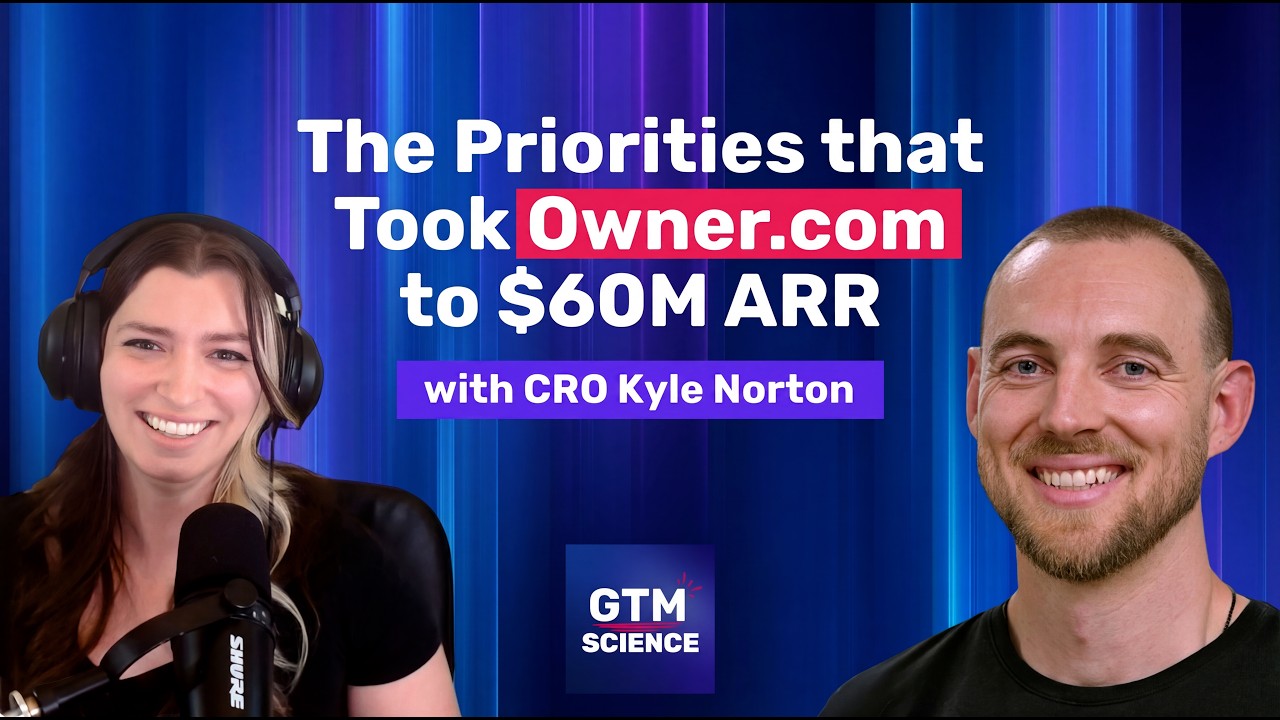
Rachael1:01And with me today is Kyle Norton, the chief revenue officer of Owner dot com, which is a Saas platform that allows restaurants to own their online operations rather than relying on third party ag with really high fees.
Rachael1:14Kyle is also the host of the revenue leadership podcast where he discusses his top go to market frameworks, Ai and sales and what high performing CRO do differently.
Rachael1:23So pretty similar to what we do here at Go To Market Science and CRO stories.
Rachael1:27So if you are found podcast podcasts, give them a lesson check them out.
Rachael1:30There's probably lot of stuff in there that you'll also enjoy.
Rachael1:32So, Kyle, thank you so much for joining me.
Kyle1:35Yeah.
Kyle1:35Thank you for the invite.
Rachael1:37Awesome.
Rachael1:37So I've really been looking forward to this one because you got some really tangible stories about what works and what doesn't work in revenue leadership, and I know you've heard a ton of other stories as well hosting your own podcast on this topic.
Rachael1:49One story that caught my eye was you helping Owner take win rates from thirty eight percent to fifty three percent in a single quarter using Ai call scoring.
Rachael2:01So that's pretty big.
Rachael2:03So I wanted to start there.
Rachael2:04Looking back at when that was happening, what was broken before you made that change.
Rachael2:09What was happening that made you feel like this was a solution you should go with?
Kyle2:15Rather than something that was broken, I think we we just always operate with a ton of curiosity and we're a very data driven organization.
Kyle2:23I could start myself to be a data driven Cro.
Kyle2:25And on a monthly basis, we are d constructing our entire funnel and segmenting and a cohort and looking at every possible cut of data we can to figure out how do we improve the business.
Kyle2:39And so I met Dave Kenneth through Gt fund event.
Kyle2:46Then mentioned he was working on Ai call scoring, and he had a, a coaching business.
Kyle2:51That basically did call scoring through these, like, outsourced coaches.
Kyle2:55And I was like, that's interesting that...
Kyle2:58That's actually a compelling dataset set to build this off of because I had looked at a couple other, like, ai sales coaching.
Kyle3:06Tools and, you know, the quality wasn't really there.
Kyle3:10And so we started to do some exploratory work.
Kyle3:13We did a pilot in the whole engagement with replay was really about understanding like, what is the science and data actually tell you about what makes a great call and what is correlated and not correlated with success?
Kyle3:28Because everybody sees, like the Gong research?
Kyle3:31You, like, man, I wish I had that.
Kyle3:33Know, they're they're inspecting, like, millions of calls and they've got fantastic insights.
Kyle3:38And so I wanted to to get a version of that for our own team.
Kyle3:43So we started doing this work, and and we were going into be open minded with whatever the findings were and it was definitely, like, surprising the results because we expected to hear that the thing was most that was most heavily correlated with win rates was discovery.
Kyle4:02Every good CRO I was like, oh, it's discovery.
Kyle4:04It's called the discovery, and it was the...
Kyle4:06It was very much not discovery.
Kyle4:07So it wasn't as much, like, hey.
Kyle4:10There's a problem we need to solve.
Kyle4:11It was it really sprang from we are always really curious to understand the data behind our business, and this was a way to get, like, even higher fidelity data on on what drives success for our specific sales reps.
Rachael4:29Yeah.
Rachael4:29So what were some of the surprising things that you found using it?
Kyle4:33So I went in expecting to hear how important discovery was.
Rachael4:38Mh.
Kyle4:39And the results, like, the replay engagement gives you, like, twelve critical capabilities or critical skills.
Kyle4:50And so, like, these were the skills out of the hundred and fifty that we analyzed that are most highly correlated with with win rates.
Kyle4:56And interestingly, ten of the twelve critical skills were all end of call.
Kyle5:02So how did you present pricing?
Kyle5:04Did you value stack?
Kyle5:06How did you set up next steps?
Kyle5:08Did you ask for the business?
Kyle5:09There was the ten critical skills that within the last, like, five minutes of a call.
Kyle5:15And that was really surprising because discovery was, like, one of twelve critical skills I expected it to be the lion's share.
Kyle5:24It wasn't, like, value articulation.
Kyle5:26It wasn't.
Kyle5:27Tailoring the solution to the specific needs.
Kyle5:29It was just like, how well did you manage the end of the call.
Kyle5:32And in retrospect, it started to make sense we're a highly transactional sales environment, the product is very compelling.
Kyle5:38It solves a compelling need and we're d facto the number one solution in our category.
Kyle5:43So it's really about...
Kyle5:45Can you just get a customer, get a prospect over that momentum and emotional enthusiasm line to get them to commit then in there.
Kyle5:57Because when you're selling to mom and pops, and when you're selling a transactional solution, excitement is everything.
Kyle6:03Mh.
Kyle6:04And it's it's it's like a very, like, a emotion driven a purchase decision.
Kyle6:08And so we trusted the data, even though it told us something that, like, we didn't...
Kyle6:14We really didn't expect and we spent...
Kyle6:16I built...
Kyle6:17We were still a small company.
Kyle6:19So I was like, building most of the enable stuff just on my own with the help of, or now enable leader.
Kyle6:26But him and I, like, we were writing content for, like, days and days and days.
Kyle6:32Mh.
Kyle6:33On how to manage the end of a call.
Kyle6:34And then we rolled this out, and we did a bunch of inspection and we did other...
Kyle6:39We did, like, daily scoring of calls just based on these end of call critical skills.
Kyle6:44And that's when we saw win rate move from, like, there would've have been thirty eight percent to fifty two Over that times span.
Rachael6:52Yeah.
Rachael6:52So did you do any experimentation of, like, well, but if we if we keep, like, the front of the call, the exact same pretty much and don't change anything and we just change how we do the back of the call?
Rachael7:02How does that change our win rate?
Kyle7:05Yeah.
Kyle7:05My philosophy on change management is to try to only change one thing at a time and do it with a lot of depth over breath.
Kyle7:12We are certainly not perfect at that.
Kyle7:15In a high velocity environment.
Kyle7:16But, one of the key pillars of my coaching mastery methodology is, like, one thing at a time.
Kyle7:23And so all we did, you know, it wasn't even, like, end of call.
Kyle7:27We broke down the sub components of end of call.
Kyle7:30Like, just how we wanna do value stack and pricing.
Kyle7:33And we did...
Kyle7:34There was three modules in the training that we rolled out over the ten weeks.
Kyle7:38And so we just did one thing at a time.
Kyle7:40Like, I recorded the videos, and we trained everybody, and then we had practice sessions, and then the managers were just...
Kyle7:49Or was only one manager at the time actually, was just doing reinforcement and coaching on only that one skill.
Kyle7:55And then once we saw those metrics going up.
Kyle7:58Okay.
Kyle7:59We feel good about how people are value stacking and presenting price.
Kyle8:02Now we're gonna teach them the setup up and tie down.
Kyle8:05So then we did that for a couple...
Kyle8:07Like, that might have been, like, four weeks, then we did the next step setting process because was, like, navigating their buying journey, understanding additional decision makers, how the next step was presented.
Kyle8:18Did you lock in a time?
Kyle8:20Like, there were there were a bunch of, like, specific things in that in just the setting and next step component.
Kyle8:27And so we just went, like, piece by piece by piece as we saw the scores go up, win rates went up, But mh.
Kyle8:33Yeah.
Kyle8:34It's...
Kyle8:35We still teach it this way today.
Kyle8:36Like, Yeah.
Kyle8:37The the same I think the scripting is almost identical today, and this was over eighteen months ago.
Kyle8:44No.
Kyle8:45Boy, this was like the full two years ago.
Rachael8:48Oh, yeah.
Rachael8:48Nice.
Rachael8:49Mh.
Rachael8:49So how did you have any resistance at all for implementing this or adopting this or getting your your sales leaders to coach on it or just your reps to to use these insights.
Rachael9:01Because I no adoption could sometimes be the hardest part for bringing in new tools and processes.
Kyle9:07We didn't have any resistance because we made it a big deal.
Rachael9:12Mh.
Kyle9:13So I'll explain, like, when things go wrong from an adoption perspective and and, like, why this was adopted so well.
Kyle9:19So generally, adoption is bad because you do one and done training.
Kyle9:23You do like, a one hour training, you say, okay.
Kyle9:26Go handle objections style.
Kyle9:27You're ready, and there's no coaching.
Kyle9:29There's no deep practice.
Kyle9:31There's no repetition.
Kyle9:32There's no progressive resistance and it's just like a one and done training.
Kyle9:36There's also no, like, there's no social aspect to the training.
Kyle9:40Mh.
Kyle9:41Social learning is a really important way for adults to build new skills.
Kyle9:46There's no reinforcement, and, ultimately, like, you get distracted with the next thing and the next thing.
Kyle9:52And so we resisted all of those typical mistakes because I've I've been teaching this, like, four eye methodology in this coaching mastery framework for a number of years now.
Kyle10:03Mh.
Kyle10:04Specifically so that we can get the adoption.
Kyle10:07And so we're only working on end of stuff.
Kyle10:11You're only working on end of call stuff for this period of time.
Kyle10:14The manager at the time was doing...
Kyle10:16The only thing he was allowed to coach on.
Kyle10:19The only thing that the reps were allowed to work on in terms of skill was end of call mechanics, and we, like, made it feel like a big deal.
Kyle10:29So we were constantly talking about this thing.
Kyle10:31We did a sp around it.
Kyle10:33We were giving them their scores every day and which they they really cared about.
Kyle10:38And so it it just had an organizational energy to it that kept it top of mind.
Kyle10:44Because you're you're oftentimes battling what's called the forgetting curve.
Kyle10:48So you teach something one time, and then I start forgetting that new skill.
Kyle10:54And so in the loss is most prominent at the beginning.
Kyle10:58And so you teach a new skill.
Kyle11:01And at the very start, you probably wanna reinforce it, like, later that day or the next day.
Kyle11:05And you do that one reinforcement, and so now you're about...
Kyle11:08The forgetting curve one like this, but you bring people's back up now with that second reinforcement.
Kyle11:13And then you...
Kyle11:14The forgetting curve starts happening again, you do another reinforcement now two days out.
Kyle11:18Okay.
Kyle11:19We're back up.
Kyle11:19And you get to a point through what's called space repetition, So the spacing between these repetitions gets greater and greater as the competence with that skill gets better.
Kyle11:31And eventually, you don't need to do any repetition.
Kyle11:35This is just like an unconsciously competent skill now.
Kyle11:38And so we were smart with the rollout, and because we spent a lot of focus on it to have that repetition, for, like, days and weeks and months as we roll this thing out.
Kyle11:52And so it's still just like a part of the Dna of the company now or the way that we pitch.
Kyle11:57But it's a step that most enable the teams miss.
Kyle12:01Awesome.
Rachael12:03Yeah.
Rachael12:03No.
Rachael12:04I really like that.
Rachael12:04It makes so much sense.
Rachael12:06So you recommend people like, have these cadences kinda like, mapped out for their sales managers to go back and rec coach these skills at certain times?
Kyle12:14Yeah.
Kyle12:14So part of the enable program has to be the adoption exercises.
Kyle12:19So, like, for us.
Kyle12:21It's usually, like, pre work.
Kyle12:23So read a thing, watch a video, go through a work ramp or go through, like, an Lms training, and then we'll do some sort of live session, so that's your social learning in small groups.
Kyle12:35So, like, you have to be accountable to the other learners because if you don't do it, your group sucks.
Kyle12:42And so people come in knowing that they have to be prepared.
Kyle12:46And then they'll do the the live lab, which is a way to like, unpack the skill, reorganize it, discuss, analyze, and then, like, actually do real practice with that thing.
Kyle12:58And so there's always, like, a workshop component, so they're building something.
Kyle13:02So, like, take a deal and based on this new framework, prepare your call plan for the next thing or, like, we're doing crucial conversations training and this trust building stuff right now.
Kyle13:16Mh.
Kyle13:16And so, like, as part of the pre work we had to do, like, a trust inventory.
Kyle13:21And so you're using the skill where we're teaching B Brown's bra model.
Kyle13:26So you're using her bra structure to analyze your relationships with, other people in your team.
Kyle13:33So it forces you to, like, engage with the content in a more meaningful way.
Kyle13:40So there's, like, this thing called Blooms taxonomy, which is, like, a pyramid of least helpful training, or at least helpful learning modalities to most helpful.
Kyle13:48Least helpful is just read a thing.
Kyle13:50The little more helpful than that is, like, read and reg.
Kyle13:53And then there's, like, analyze, interpret, and the, like, the top most useful thing to to actually learn a skill create something out of that new skill.
Kyle14:01So you're creating your trust inventory.
Kyle14:05And then you were gonna have people pick a crucial conversation that they wanna have with somebody else that they've been avoiding and they're gonna do the the crucial conversations pre work to, like, get ready for that conversation, prepare themselves, build a talk track, you'll have that conversation with somebody.
Kyle14:22And so, like, these things are spaced out.
Kyle14:25This whole course is spaced out over twelve weeks ish, something like that because we've got the holidays in there.
Kyle14:32So we're doing, like, the trust inventory stuff, the be brown workshop, and we're gonna do the front end of crucial conversation, which is about us and preparing for the conversation, then the conversation mechanics and, like, so we're...
Kyle14:44And you're constantly coming back to the thing that you learned previously.
Kyle14:48And so all of that, space repetition and, like, practice is is actually built into the enable programming, and then it's the manager's job to go and do, like, specific reinforcement activities.
Kyle15:05And they'll do the reinforcement activities.
Kyle15:07They'll do the coaching on the topic by coming back to this end of call stuff.
Kyle15:11Like, in their weekly coaching meetings, and everybody has, like, a separate coaching meeting from their one on one book every single week, they'll do coaching on only that topic that we're trying to build learning density around.
Kyle15:25And that...
Kyle15:27That's the sort of the repetition that I'm talking about.
Kyle15:29So it's it's course design.
Kyle15:31It's having the coaching reinforcement.
Kyle15:32You need an expert feedback mechanism, expert feedback is an important part of the learning journey?
Kyle15:38And so how are you inspecting the skill and looking at it on a rollout basis.
Kyle15:44And so just all of this has to be, like, we call it our learning experience design playbook.
Kyle15:49So when you're...
Kyle15:51When you wanna do a course or when you wanna teach something new you use our our learning experience design playbook to make sure that those things are in there and the whole enable team's trained on it and awesome.
Kyle16:03Yeah.
Kyle16:04It's it's a lot of work.
Kyle16:05But, like, Yeah.
Kyle16:06You actually can build skill this way.
Rachael16:08Yeah.
Rachael16:08No.
Rachael16:09That sounds awesome.
Rachael16:09That's such a, like, an in...
Rachael16:11Scientific, way to approach adoption.
Rachael16:14And, you know, it makes sense.
Rachael16:16Like, here at, you cb always say or Eddie always says, like, the tools aren't gonna save you.
Rachael16:21And I think this is a really good example of that, like, any company could probably get what was this replies out got Io owe and get these insights and stuff, and then just be like, okay.
Rachael16:32If you have these insights, you know, everyone just make sure you keep an eye on that, but that isn't gonna increase your win rates by, you know, thirty eight fifty two percent.
Rachael16:41It's like having this adoption, like, having this huge huge focus on improving this piece of the sales call, they were able to determine with data was so incredibly crucial to winning these deals.
Rachael16:53So no.
Rachael16:55I love that.
Rachael16:55That's awesome.
Rachael16:56Do you use that, like, coaching that that framework with every, you know, data insights that you find across go to market?
Kyle17:09When you say that, like, when I learned something, do we apply the coaching mastery approach every time?
Rachael17:15Yeah.
Rachael17:15Like, it is anything that needs adoption from your team?
Kyle17:19No.
Kyle17:19No.
Kyle17:20Some things because, you know, like, we have this traffic light model of of change management.
Kyle17:25So sometimes there's a green light challenge.
Kyle17:28Like, I just need to give you an update that the field you use in Salesforce used to be x and now it's y.
Kyle17:35So here's a heads up.
Kyle17:36You can basically deploy that with a Slack message.
Kyle17:39The problem is people try to roll out, red light changes with a Slack message.
Kyle17:44Mh.
Kyle17:44In our world, like, a red light change is something that is, like, significant in nature and, like, changes Like, it's mission critical.
Kyle17:55It changes the way that they're doing their job, we'd think that the skill needs to be verified.
Kyle18:01And so when we do a red light change we wanna have, like, multiple channels, multiple medium.
Kyle18:09Because different people are different types of learners.
Kyle18:11So there's a Slack post and a video and a guru card, and a work ramp training and people are reinforcing it in their team meetings, and I might talk about it.
Kyle18:20On an all, like, on a town hall.
Kyle18:23So you you don't you don't need to go, like, super overkill for every change depends on, like, how big of a behavior it is.
Kyle18:32But in general, like, when we're trying to teach something new and we really want people to approach their craft in a different way, than...
Kyle18:42Yeah, That's like the that four methodology.
Kyle18:45So introduce, isolate, integrate inspect.
Kyle18:50That that's part of the the coaching approach, and then that idea of, like Blooms taxonomy using adult learning principles to make sure that the content is built in the most engaging way to build the most skill, like, all of those things are in this learning design playbook.
Kyle19:06So when it's big we follow it to a tee.
Rachael19:10Did you guys develop that that coaching the four framework?
Kyle19:14Mh.
Kyle19:14Awesome.
Kyle19:15Yeah.
Kyle19:16I actually borrowed it from so I was in a mixed martial artist for years and and, c owned a martial arts academy.
Kyle19:25And and I got to train with a lot of, like, elite athletes, and, you know, like, multiple time U usc world champions and and Fuji World champions.
Kyle19:34And so I got to see what Elite coaching looked like up close.
Kyle19:37And this guy, Matt Thornton, who's the founder of Straight glass Gym.
Kyle19:41So this is where, for an Fans.
Kyle19:43This is where Conor Mcgregor got his start.
Kyle19:45This is where, like, some of the greats of grappling got their starts.
Kyle19:49And so he had this three eye methodology, which is introduced isolate integrate.
Kyle19:55I added inspect because of the nature of what we do.
Kyle19:59And I poured over his stuff to this world.
Kyle20:03And so that's when I was really That's when it.
Kyle20:06I was really like, man.
Kyle20:07There's probably a whole bunch of elite performance approaches that I should be porting over to how we teach the craft of sales.
Kyle20:14And as I started to, like, read more books like, if you wanna a starting point, people should read the talent code by Daniel Coy, which talks about the science of skill building and the the neuroscience...
Kyle20:27The the, like, biologic process of my nation, which is, like, your brain building a new skill.
Kyle20:31And once you start unpacking that, you're like, oh, then you're learning with bloom taxonomy and andrew go g and out learning principles, you start to understand you're, like, oh, wait.
Kyle20:40So, like, most of how most companies do enable totally sucks.
Kyle20:44And so we've like, pulled a bunch of this stuff into our own approach.
Kyle20:51And so we have an amazing enable leader and quite a large enable team for the size of business we are.
Kyle21:00Because we take this so seriously, and it is like a compounding advantage that we have.
Kyle21:05The fact that we can deploy new skills and the level of craft here, I think is so much better than most places and certainly our competition.
Kyle21:13So we've spent just, like, a a ton of time on it.
Kyle21:16And we've also got, you know, a the woman who wrote the learning design playbook.
Kyle21:22She's a Phd and, like, you know, very experienced feature and and has so much depth in sort of the learning science that we're just, like, pressing farther and farther into this, like, science based approach.
Rachael21:40I love that as a as a personal you, like, psychology and behavioral science nerd there's absolutely rabbit hole that I want to get into this week.
Kyle21:49Yeah.
Kyle21:49There you go.
Rachael21:51And, hey.
Kyle21:52Yeah.
Kyle21:52If people wanna read, a couple good books.
Kyle21:54The talent code by Daniel Coy is number one, And then, what is it called?
Kyle22:02Adult learning.
Kyle22:03Maybe we'll put this in the show notes.
Kyle22:06There's another book written by the guy who's sort of, like, invented this field.
Kyle22:11This might be him at Malcolm k.
Kyle22:14And it really unpack like, how adult learning is so different than childhood of learning.
Kyle22:21Like, mh.
Kyle22:21You have to convince an adult why they should learn a thing before you can teach them that thing, which is, like, very different than kids in many ways.
Kyle22:28Yeah.
Kyle22:29And needs to, like, that's where the social learning stuff comes from.
Kyle22:32That's where you need to make it, like, you have to establish learning relevance, you know, like, talk about examples from their specific experience that tie into this new craft.
Kyle22:44The motivation needs to be internally driven.
Kyle22:46They need to, like, want to lean in.
Kyle22:49So there's just a whole bunch of these these principles that once you learn them, it's pretty straightforward, but Yeah.
Kyle22:54You just have to The application is the hard part.
Rachael22:57Yeah.
Rachael22:57Yeah and getting everyone on onboard that idea.
Rachael22:59But, hey, if you ever need, like, another side hustle, you can just become a a scientific enable coach.
Kyle23:05On the.
Rachael23:06You've got...
Rachael23:06You got the backing for it.
Rachael23:08Got the brain for it.
Rachael23:09That's awesome.
Rachael23:10And I...
Rachael23:11And, like, so so applicable for a CRO rule as well.
Rachael23:13Already kind of a c suite role or it's a manager role, really, just be able to, like, know how to train your team.
Rachael23:21On stuff that going to help them in their own skills, you know?
Kyle23:26At the end of the day, our entire job is behavior change.
Rachael23:29Mh.
Kyle23:30We're trying to change the opinion and behavior of our teams so they can change the...
Kyle23:35The opinions and behavior of customers.
Kyle23:39Mh.
Kyle23:40And if you can't get people to do new things, learn new skills, then you're gonna have a very difficult time building building a great company because either you're just, like, paying tip top market for tenured reps because you don't wanna teach them, and they're all gonna come in and do it slightly different ways, and there's no symmetry to how you, like, execute And so I I think this is one of the most important skills that somebody could open could learn.
Kyle24:09And there's only a handful of books and then you sort of have it figured out.
Kyle24:13Like, the you you you start to see the pattern.
Kyle24:15And I wrote an article called the...
Kyle24:18I wrote an article.
Kyle24:19It just search, like, my name and coaching Mastery, and that's on my subs stack.
Kyle24:23And I go through my, like, five coaching mastery principles, and but I've written about the four I thing elsewhere.
Kyle24:30So Also all.
Rachael24:32Yeah.
Rachael24:32We can put that in the show notes as well.
Rachael24:33So people can.
Kyle24:34Mh.
Rachael24:35Click off to that.
Rachael24:35Alright.
Rachael24:36So moving on.
Rachael24:37Let's go back in time a little bit.
Rachael24:39So you joined Owner as an Sp of sales and partnerships and then moved into the CRO role.
Rachael24:44What was the biggest operational gap you discovered once you had that broader view across the entire revenue organization?
Rachael24:51Everything.
Rachael24:52Usually haven't goes.
Rachael24:55Right?
Rachael24:55Yeah.
Kyle24:56Yeah.
Kyle24:56Like, you know, we were two and a half million Arr, the time and we're, like, over sixty today.
Kyle25:01And so the the, like, the business was just fundamentally different.
Kyle25:05I I was having this conversation with a friend yesterday, like, the job I did, you know, whether my title was Sv or Cro, the job I was doing was actually salesman.
Kyle25:15Like, you do a little bit of CRO job with your time at that stage, but actually, day to day, like, most of what your job is, is sales manager.
Kyle25:26And you're one on one in the trenches with reps.
Kyle25:30You're doing things yourself, your pitching deals like, in the trenches, and you're just slowly, but surely trying to build the machine around you.
Kyle25:41And then you end up hiring or promoting people into that role, so then you're...
Kyle25:46Like, now that's not your job.
Kyle25:48So you put somebody into the manager job.
Kyle25:51And so now I'm mostly doing the director job.
Kyle25:54And spending what's left of my time on the other levels of abstraction.
Kyle26:00So, like, Sv p or a vp job and the CRO job, like the executive job.
Kyle26:04Mh.
Kyle26:05And then you get somebody these director roles.
Kyle26:07And now you're not spending, you know, fifty percent of your time being the director, they figure out how to hit the number.
Kyle26:13They deal with the, like, hiring and and personnel stuff and dealing with just like the day to day issues of running a a larger team and and so you you just, like, slowly start to work on a different level of abstraction in a in a different timeline.
Kyle26:31So now like, in my job, most of what I do is thinking about stuff that has, like, a multi year payoff.
Kyle26:38Mh.
Kyle26:39You know, like, one of our big bets this year was moving from a fully remote culture to in sales hiring every net new Bd and inside rep in Toronto.
Kyle26:52And so that was, like, a huge bet.
Kyle26:55It's got a multi year implication and it has, like, a compounding benefit.
Kyle27:02And so, like, that was a thing.
Kyle27:04Pricing.
Kyle27:05I've been working...
Kyle27:06Spent the last twelve months working on finding a pricing with Milton We're doing all this research.
Kyle27:10We're rolling out this new pricing methodology.
Kyle27:13And, like, again, that's work that sort of had...
Kyle27:19Could not have existed when I was a five million dollar CRO because I just, like, wouldn't have had the time available to do it.
Kyle27:28And so that's how I sort of think about that journey.
Rachael27:31Mh.
Kyle27:32I don't know if that's very direct to answer your question, but...
Kyle27:33No.
Rachael27:34No.
Rachael27:34It's interesting.
Rachael27:34How the...
Rachael27:36Like, like, each each stage of the business as you guys ramped up more and more.
Rachael27:41How did you figure out how to, like, prioritize your focus on areas that seem like they're kinda broken or the metrics aren't as reliable or visible.
Rachael27:51How did you...
Rachael27:51Yeah.
Rachael27:52How did you figure that out?
Kyle27:54So I smile because this is a a zillion dollar question.
Kyle27:56Yeah.
Kyle27:57Yeah.
Kyle27:58Per like, in fast growing business prioritization is the is the biggest problem because there's a quote for my friend, Dan Ross, so I worked with a Shopify.
Kyle28:05He's, like, we have Wayne more good ideas than we have pan.
Kyle28:08No.
Kyle28:09Yeah.
Kyle28:09And, you know, it's a champagne problem.
Kyle28:11Like, honestly, an Owner, there are a hundred things that I could work on that would be really impactful for the business.
Kyle28:18Especially being, like, optimistic excited passionate people we wanna say yes to it all because we're like, that's a good idea.
Kyle28:27And is a good idea.
Kyle28:28We should do these things and and but every time you add something new you're diluting your focus on those other things.
Kyle28:33And so it was doug Bell on the Cannonball subs stack, the Cannonball newsletter.
Kyle28:42I I presented this, like, Ai adoption presentation at at this...
Kyle28:47At those guys event called Ai barf on my computer or something like that.
Rachael28:53That's the event needs.
Kyle28:53This is...
Rachael28:54Yeah.
Rachael28:54Oh wow.
Rachael28:55That's weird.
Kyle28:58And this this is Jordan crawford and doug bell.
Kyle29:00They're funny funny guys.
Kyle29:01So I gave this presentation.
Kyle29:03And you wanted to go me to go deeper on this mess methodology because I have this, like, five p approach to prioritization, which I've adapted from Any do crew wrote thinking bets and and how to decide.
Kyle29:15And So you can read it on his subs stack.
Kyle29:19It's a well written article.
Kyle29:20And so, basically, you wanna, like, map all your priorities.
Kyle29:23Like, what are the things that are important for you to do?
Kyle29:26What are all the possibilities?
Kyle29:27So, like, what are the ways we can solve these problems?
Kyle29:31And there's opportunity solution tree or Kai five wise?
Kyle29:35Like, to get to the root cause problems that you wanna solve.
Kyle29:39But, like, where are all the possibilities to solve those problems.
Kyle29:41What's the payoff just ins solving those problems?
Kyle29:44You know, if this is a ten million dollar Arr win versus a one million dollar Arr win.
Kyle29:50Okay.
Kyle29:51This should maybe take more precedence from a ironing per perspective.
Kyle29:53But then you have to think about the probability?
Kyle29:56What's the probability that this works out?
Kyle29:59And so maybe you have a seven million dollar payout and a five million dollar payout.
Kyle30:04Just...
Kyle30:04It's hard to quantify these things, but just like for round numbers.
Kyle30:07Mh.
Kyle30:07But the seven million dollar, like, project is very speculative.
Kyle30:10You're like, going to us.
Kyle30:12I have no idea if this is gonna work.
Kyle30:14It's like, a fifty fifty bet.
Kyle30:15But it's like ninety percent likelihood to work in the five million dollar payout.
Kyle30:21So now you're getting to expected value.
Kyle30:23So seven million dollar payout, fifty percent likely, which means there's an expected value of this project of three point five million dollars.
Kyle30:31Conversely, you've got five million at ninety percent.
Kyle30:34That's a four point five million dollar payoff or, like, expected value, not path.
Kyle30:39And so you're you're actually gonna wanna do the one that is slightly lower payoff because it's much more likely.
Kyle30:47And so you're getting to expect the value that's a big the big any due thing.
Kyle30:51And then the final thing you have to consider is, like, what's the required?
Kyle30:55Like, how much effort in because, again, like, if the...
Kyle31:00If one has tons and tons of work required, and one has very little that that will affect what you're gonna wanna do, and then that feeds like what you prioritize.
Kyle31:10The other thing about preparation is, like, who's corporation.
Rachael31:15Right?
Kyle31:15Because maybe this is, like, you know, quite a bit of your effort, but a lot of another team's effort and if they don't prioritize this project, then you're sort of out of luck.
Kyle31:25And so especially in bigger companies, and we're spending a lot of time on this right now as the company becomes so much more matrix and cross functionally dependent how do you map who thinks what is important in lining up all these road roadmap.
Kyle31:40So, you know, sales doesn't start working on a project get eighty percent of the way there and then need enable or data or product?
Kyle31:49To get over the last twenty percent, but they're, like, well, we didn't have this on a road map.
Kyle31:53But, what are you...
Kyle31:54Like, I I can't work on this for five weeks.
Kyle31:56And now Yeah.
Kyle31:57Our team has spent all of this time and energy working on something that gets stalled.
Kyle32:01And and so the road map alignment especially in companies that are in the, like, twenty five fifty million plus range, like, that tax is very high.
Kyle32:12I'm sure you guys see Mh.
Kyle32:13In your line of business.
Rachael32:16Yeah.
Rachael32:16That's...
Rachael32:17That is so much more in depth.
Rachael32:19You know, like, we have an article, I guess on the go to market ops decision tree.
Rachael32:24So it's, like, a little much more simplified tool of, like, here are the questions to ask and, like, should you focus on this versus this?
Rachael32:31Okay.
Rachael32:31So within this branch, should you focus on this versus this, like, new business?
Rachael32:34Should you focus on inbound versus outbound or through renewables or something like that.
Rachael32:39But I love that this...
Rachael32:41Like, what you just explained adds the whole deeper layer to it more mathematical, kinda like, scientific layer to it because it might not be.
Rachael32:49So obvious it's just, like figuring out where the bottleneck is or where the biggest opportunity is because something that's the biggest opportunity in air quotes on paper, might not actually match up with the math when you look at it a little bit deeper.
Kyle33:03Yeah.
Kyle33:03And you don't have to run a spreadsheet every time.
Kyle33:06In fact, that's like, not super pragmatic.
Kyle33:08It's more of a mental model.
Kyle33:10To continue to remind yourself, you know, what's the payoff?
Kyle33:14What's the probability?
Kyle33:15And and really, like, what are all of the possibilities?
Kyle33:18Because oftentimes you're in a meeting.
Kyle33:21Like, that's a great idea.
Kyle33:22We should do that.
Kyle33:23And you have to stop and say, Okay.
Kyle33:26Like, what else do I have I said I wanna do and is this more important than that thing?
Kyle33:31I I, literally said this to somebody on a meeting yesterday.
Kyle33:33Like, oh, man.
Kyle33:34This sounds really important.
Kyle33:35Is that one of your top three things that you need from this other team?
Kyle33:39Yeah.
Kyle33:39That person was like, no.
Kyle33:41Actually, there's, like, other things.
Kyle33:42And just like, consistently having a muscle to to encourage everybody around a table to force rank.
Rachael33:53Right.
Kyle33:53It's like, is this the number one most important thing?
Kyle33:55If not, what is...
Kyle33:56And then, like, we wanna consistently be trying to only work on the top one or two most pressing things with big impact and high probability
Rachael34:06I feel like every week, we're trying to do that in our own business too, because, like, I'm a marketing team of one.
Rachael34:09I only have so much bandwidth.
Rachael34:11Eddie does a lot of marketing stuff as well being subject matter expert and most of our content.
Rachael34:15And he only has a certain amount of bandwidth that he can spend on marketing.
Rachael34:18So that's a constant, like, juggling act figuring out what is our highest priority and what will make the most impact with the least amount of effort.
Rachael34:25So...
Rachael34:26Yeah.
Rachael34:27And I don't want this to be, like, a plug for us or anything.
Rachael34:29But at what point do you think Zeros should look at looking into, like, third party, like, outside help to relieve some of those execution bottlenecks?
Rachael34:38Like, at what point does it make sense?
Kyle34:41So it's an interesting question.
Kyle34:43I'll sort of explain what we did, and then I can like loop back.
Kyle34:49So we had one more execution style sales operations person working with us.
Kyle34:58And then I started and pretty quickly as, like, you know, I wanted to to build the right foundations to really scale hard on.
Kyle35:07I got my previous head of Rev ops working with me on contract.
Kyle35:12And, he did that for four to six months, something like that, just to sort of manage the burn implication, and then as soon as I could, I brought him in full time.
Kyle35:26And so Steve's worked with me for almost ten years across three companies.
Kyle35:30And if you have that, then I would just spend the money.
Kyle35:35This is not the answer you guys wanna hear.
Kyle35:37But Still fine.
Kyle35:38I would just spend the money and get somebody awesome full time in the door as early as you can.
Kyle35:44Mh.
Kyle35:45Because the world is is more operationally driven and data driven than ever, like, you know, not just because of Ai, but Ai is certainly, like, a piece of that.
Kyle35:57So you wanna make early investments in in Rev ops.
Rachael36:00Mh.
Kyle36:01If you don't have that person close buying your network that trusted individual, then, certainly partnering with somebody who's really good on Rev ops consulting can make a ton of sense, especially if they've done similar work and they've seen similar playbook.
Kyle36:17But you have to be really careful.
Kyle36:20Like, you have to be really mindful of who you pick to do Rev ops consulting for you.
Kyle36:26Mh.
Kyle36:26Because if they aren't aligned philosophically, everything will suck, if they've never done that type of work, it will be it will be challenged, and I will personally encourage people to, like, vet these investments really hard.
Kyle36:42Absolutely.
Kyle36:43Yeah.
Kyle36:44And, like, work from personal recommendations is the other big piece of it.
Kyle36:49And if you have somebody awesome that's working with me on a consultant basis, that can take you a long way.
Rachael36:54Mh.
Kyle36:55And you should consider yourself lucky if you have that that type of relationship.
Kyle37:00And oftentimes it's, like, not that much more sense expensive so than having a full time chris.
Rachael37:04Yeah.
Kyle37:05So Sure.
Kyle37:05Yeah, That's generally how I think about it.
Kyle37:07I I, you know, my advisory work.
Kyle37:09I get people hooked up with Rev ops consultants in, you know, like, when they're, like, one two million Arr.
Kyle37:17To change for sure.
Kyle37:19Or else, you just start building yourself, like, a huge tech debt.
Kyle37:23My bias though is to to do this stuff early.
Rachael37:26Yeah.
Rachael37:26Yeah.
Rachael37:26Absolutely.
Rachael37:27And you mentioned it's something that we might not wanna here, But, actually, I think it's the opposite offset.
Rachael37:31We we love knowing that, you know, if people have a Rev ops team and they actually care about this stuff.
Rachael37:36I think some of the easiest and best clients we have ever worked with are ones I have Rev ops team and we just, like, come in for helping with execution and strategy and stuff.
Rachael37:44But it's like, trying to draw blood from a stone if the person you're working with.
Rachael37:51They don't have any Rev ops team and they don't not only that, but they don't see the value in it, and that's why they don't have the red ops team.
Rachael37:57So, yeah, Definitely make stuff easier when there's, like, value and investment already put into this kind of stuff.
Kyle38:03Yeah.
Kyle38:03I agree with you there.
Kyle38:04I I think, like, regardless of the channel if it's, like a full time in house person or somebody that's consulting or contracting, bring them in earlier than most people expect.
Rachael38:17Yeah.
Rachael38:17You're gonna be paying a lot and more money later on to fix it.
Kyle38:21Yeah.
Kyle38:21And it's just, like a pain in the bud and and The incremental cost is not that significant.
Rachael38:27Mh.
Kyle38:28Like, to do things the right way.
Kyle38:29The the other piece of advice I'd give to people, like, where I see this go wrong is they want, like, a hyper personalized Crm when mostly out of the box stuff would be totally fine.
Kyle38:43Like, yeah.
Kyle38:43We're a sixty million dollar arr company more than doubling every single year, and we use mostly out of the box functionality out.
Kyle38:50Mh.
Kyle38:50Like, we have very little, like, custom objects, Apex code, we're not in environment that has, like, whole bunch of wacky stuff happening.
Rachael39:01Yeah.
Kyle39:01And I see companies that are, like, less sophisticated than us with less complexity doing, like, oh, I've got a custom object for this thing, and I've got this automation going here.
Kyle39:11Like, man, that's just so much.
Kyle39:13Yeah.
Kyle39:14It's such a high cost to bear For incremental customization.
Kyle39:18Like, my advice to sales leaders and to founders is very frequently.
Kyle39:22Especially before you're, like, ten million.
Kyle39:26Just use the tools out of the box and make slight tweaks to how your business operates to make it easy to work with the tools.
Kyle39:34Don't start cram in custom objects and a bunch of Apex code.
Kyle39:38To, like, get some marginal, like, flexibility from the tool because you always end up scrapping that stuff and Apex slows down your instance, and mh.
Kyle39:50Makes it harder to plug in to external tools.
Kyle39:52Like, if you have custom for stuff, a bunch of external tools aren't gonna out of the box integrate with those objects.
Kyle39:58Most of the time they won't.
Kyle40:00And so you just use, like, incur this cost for a very marginal benefit.
Rachael40:06Mh.
Rachael40:06Yeah.
Kyle40:07And then it's cheap.
Kyle40:08That's the other...
Kyle40:09That's why I wanted to get out of this point.
Kyle40:10Because then it's cheap to work with consultants.
Rachael40:13Yes.
Kyle40:13Like, you, you know, it's not super complex or they're not paying for, you know, like, expensive developers.
Kyle40:18You're just doing out of the box stuff.
Kyle40:20Roll with that for till ten million arr and then, like, make an assessment to really need that stuff.
Rachael40:26That's why we say, like, you know, the tools won't save you because you you can't have, like, a a ton of a huge tool stack really complex, you know, integrations in crm and everything and expect that to make to help you win more revenue.
Rachael40:39It's the process behind everything.
Rachael40:41It's like, how you build your business, and the tools are just that.
Rachael40:44They're just tools.
Rachael40:45But if your process isn't guiding your tools and how you have everything set up, then you're not really gonna get very far.
Kyle40:53No.
Kyle40:53And and so Jason Can wrote an amazing article on how they're using Ai in their go to market stack, and he's, like, Ai only s inbound Sdr r Ai only outreach, Ai quoting, like, he's taken it so far.
Kyle41:11And one of the points that he makes in the article is you can't scale something that's broken.
Kyle41:18Like, Ai will just give you leverage and scale.
Kyle41:21And so you have to actually figure out how a thing works by hand really, Yeah.
Kyle41:29Before you can slap Ai onto it.
Kyle41:32Yeah.
Kyle41:32And so you...
Kyle41:33He and I were emailing about it after, like, one of the things that we were talking about is, like, you're in this cold start pro problem.
Kyle41:40Because, like, you don't wanna hire a bunch of Bd to figure something out to then just, like, have it done with Ai.
Kyle41:46And so, like, who does that work?
Kyle41:49And the unfortunate answer is, like, you just have to do it as the founder or as the revenue leader and it's gonna be sort of painful, and it's gonna be, like, more in the weeds than maybe you would care to be.
Kyle42:02But you have to get into the weeds in these things to figure it out to make it work at scale, so then you can, you know, zoom way back out.
Kyle42:12Yeah.
Kyle42:13And, like, Le himself is in these tools.
Rachael42:16Yeah.
Kyle42:16If Jason F Le can can be, like, tuning Ai, Bd r's and, like, making scripting updates himself for multiple hours a week.
Kyle42:25You, mister Vp of sales at a series a series b company or founder could be could be doing that.
Kyle42:32As well.
Kyle42:33So I would encourage everybody to go read the article.
Kyle42:36Because it's one of the better ones I've on this topic.
Rachael42:39Yeah.
Rachael42:39And we put out, like, ton of content on this as well.
Rachael42:42Because that's like the majority of what we focus on is making sure that your processes are intact, and you have the fundamentals.
Rachael42:46The foundations all built up and you have good found, adoption rolled out when people are actually following your processes.
Rachael42:52Before Caring too much about, like, systems architecture and stuff.
Rachael42:56That's why we changed we used to call ourselves, like, strategic rev ops, and now we we kinda rebranded to go to market ops because people hear Rev ops, and they think just systems architecture or, like, No.
Rachael43:08It's so much more than that.
Rachael43:09There's, like, so much that goes beyond just, like, doing the the Crm building and the tech stack and everything like that.
Rachael43:15But it's easier to re brand and then to convince people to think of Rev a completely different way.
Kyle43:21Yeah.
Kyle43:21Yeah.
Kyle43:22I think it makes a ton of sense.
Kyle43:23The the framing the framing is is the right thing.
Kyle43:27Yeah.
Rachael43:28So I wanna go back.
Rachael43:29You mentioned Owner of being, like, a sixty plus million arr.
Rachael43:32So you guys took or you you helped take an Owner from around two million to sixty plus million Arr and unicorn status, I believe in in about three years or three, four years?
Kyle43:43Yeah.
Kyle43:43Three in a it.
Rachael43:44What were some of the biggest operational factors that you think contributed to that growth?
Kyle43:49I've already mentioned it early investment in tools, Mh.
Kyle43:51And and infrastructure and technology and and the teams around it.
Kyle43:56Like actually, the content of this conversation is basically our secret sauce, we were always playing big.
Kyle44:02You know, like, I didn't join Owner to be like, oh, yeah.
Kyle44:05Like, we wanna build this, like, cool, pluck startup, and, like, maybe we'll sell to private equity for a couple hundred million bucks.
Kyle44:12Like, I never would've have left my job at Shopify fight for that.
Kyle44:14I joined Owner solely because, like, Adam and everybody around the table.
Kyle44:19We are playing for the grand slam outcome.
Kyle44:23Like, we wanna build a generational company, and that's not a billion dollars.
Kyle44:28That's not ten billion dollars that's a much, much grander outcome.
Kyle44:33And so if you operate with that frame of mind then making these early investments in the right foundations that have compounding benefits later is sort of obvious.
Kyle44:44And so, you know, like, our enable team was, like, twice or three times bigger than most people would have at some of our company building stages.
Kyle44:56Our Rev ops team is, like, significant compared to the sort of stage of company.
Kyle45:02Net now it's normalizing, like, the company is growing into the size of those schemes, but I diverted a, head count spend from hiring a whole lack of reps into hiring people in these functions because it makes every rep more productive and it gives us so much more leverage.
Kyle45:19And so now we have these awesome foundations that we're, like, moving fast even, you know, as we try to onboard, you know, we're gonna hire an onboard, like, twenty five X in the next ninety days, Six days really.
Kyle45:32And you can only do that because we've just got, like, an absolutely dialed in new sales hire onboarding plan.
Kyle45:40And they can sit down and get into the tools and, you know, the documentation is really, really strong.
Kyle45:46Like, we've done all the each your vegetables stuff early so that now we have this this, like, advantage of scale and speed.
Kyle45:54And and leverage.
Kyle45:56Mh.
Kyle45:57I would say, like, more than anything that has being one of our biggest drivers, like, helps have an awesome product, of course.
Kyle46:05Yeah.
Kyle46:06We've got, like, incredible talent around the business.
Kyle46:09And we've held such a ridiculously high talent are that, you know, like, the marketing people I rely on are f off.
Rachael46:19Mh.
Kyle46:19And the data team that I get to partner with is incredible.
Kyle46:23The product organization strips at a ridiculous pace.
Kyle46:26And so, you know, like, I get a lot of credit for the girl's story, but, like, you know, I've me and the team, like, the sales team who wouldn't have been able to do anything without all of those other things be, like, incredibly dialed in.
Rachael46:41Mh.
Kyle46:42And so the, you know, a lot of the master plan is just just like crazy talent density go higher the best of the best of the best and let those people cook.
Kyle46:52Mh.
Kyle46:53And I would say those are sort of, like, the maCRO advantage we've had is talent density and the go to market advantages of being, like, early investments into compounding assets.
Kyle47:05Mh.
Kyle47:06Like, foundations that accelerate everything else.
Kyle47:10Same with our Ai investments.
Kyle47:11Like, we we've got eight, you know, like, production use cases of Ai that are generating, like, really significant enterprise value, you know, those were a bunch of work and we did it early, but now we've got these things that just that absolutely read.
Rachael47:28Yeah.
Rachael47:28Yeah.
Rachael47:29What's the story behind your revenue leadership that you don't get to tell often enough?
Kyle47:36So a buddy you I was talking to yesterday?
Kyle47:38He's like, why don't you ever talk about the Martial arts that he's, like, it feels because we got onto the topic.
Kyle47:42He's like it feels like it's so much a part of your, like, Dna and personality and mindset, and and he's, like, I never hear you talking about it on.
Kyle47:50I'm like I don't know It feels like I guess it feels quan.
Kyle47:53No.
Kyle47:54I I talked about it more early in my podcast career, but you know, I I guess it is something I just take for granted.
Kyle48:04You know, the biggest lessons that I took for Martial arts were learning to lose and just, like, learning to, you know, when you're spa, you're gonna get tapped and, like, lose that exchange.
Kyle48:15Like, many, many times in just one training session.
Kyle48:19Mh And you learned, like, never even, like, blink it at that loss because it's not a loss.
Kyle48:24It's just, like, you're just training and learning.
Kyle48:26And and so I got good at responding to feedback and, like, getting better at something through, like, real world, like, physical feedback.
Kyle48:35And just like the mental tough from it.
Kyle48:38Mh.
Kyle48:38Every day, you just get beat the heck up.
Rachael48:41Yeah.
Kyle48:42And and nothing will prepare you for the world of sales and startups and building go to market and just getting physically beat up.
Kyle48:50Yeah.
Kyle48:51Multiple times a week, Yeah constantly.
Kyle48:55And and I think, you know, whether it's martial arts or running or swimming or lifting weights, the message really is you need to find some endeavor outside of work that pushes you beyond your physical limits so that you can, like, understand what you're capable of, and you can build the confidence in yourself that you can do really hard things.
Kyle49:21Mh.
Kyle49:22Like, I like hiring marathon runners.
Kyle49:24We have, like, a bunch of long distance runners on the team, and I think, you know, like, running sucks.
Kyle49:30Yeah.
Rachael49:31But God.
Rachael49:31I hate...
Kyle49:32And running running for three or four hours sucks bad, and you, like, learn to love that and you learn to to, like, just do it because it's good for you.
Kyle49:42Mh.
Kyle49:43And I just builds, like, a mental tough that I think takes you so far in sales because I I really think it's missing so much these days.
Kyle49:52The world is easy and kids are raised on ipads, and the way that we've, like, you know, treated kids over the last ten or fifteen years.
Kyle50:02And Jonathan Height talks a lot about this in his book called the cod of the American mines.
Kyle50:07But, like, people don't have ways that they're building resilience.
Kyle50:11And and experiencing failure.
Kyle50:13And so I think, like, leaning into into whatever it is.
Kyle50:16Yeah.
Kyle50:17Like, Martial is an awesome way, but swimming, biking, triathlon on, like, I could be pickle ball.
Kyle50:24Like, do it hard.
Rachael50:26Like something.
Kyle50:27Yeah.
Kyle50:27Maybe not pick up.
Kyle50:28It's not hard enough.
Rachael50:29Yeah.
Kyle50:29You gotta pick something that's, like, really difficult and me be like, you didn't you don't know if you could do.
Kyle50:34You have to go into it knowing you might fail.
Kyle50:36Yeah.
Kyle50:36I love that Yeah.
Kyle50:39That would be maybe, like, the thing I don't get to talking about much.
Rachael50:42That's cool.
Rachael50:42I love it.
Rachael50:43And I also love Martial Arts.
Rachael50:44So I love hearing about your take on that as well.
Rachael50:46But we are all at time, so I don't wanna take up your time you anymore, but real quick, Kyle, Where can people find you?
Kyle50:52Hit me up on Linkedin.
Kyle50:52And then you can check out the subs stack, just the revenue leadership podcast dot com.
Rachael50:57Okay.
Rachael50:57Awesome And we'll have that in the show notes as well, but thank you so much, Kyle for joining me today.
Rachael51:00This is great.
Kyle51:01Yeah.
Kyle51:01Thanks so much for the invite Rachael.
Intro/Outro51:06Thanks for listening to the show.
Intro/Outro51:07If this resonated, and or you'd like help with anything we talked about in the show, please reach out to us.
Intro/Outro51:12You can find us at Union Square Consulting dot com and the info will be in our show notes.