EDDIE0:00if we just give everybody licenses in the organization, we're like, have at it.
EDDIE0:03You're not going to get
EDDIE0:04results that are going to move the needle.
EDDIE0:05You're going to get these little efficiency gains where everybody is like, figure it out.
EDDIE0:09I can save ten minutes here in ten minutes here. But we're not seeing that impact revenue
EDDIE0:12was looking at
EDDIE0:13a customer's org a while back and they had $100,000 sales opportunity.
EDDIE0:17And this isn't just one sales opportunity. This is just the one random one I happen to look at.
EDDIE0:21And they had $100,000 sales opportunity. That was close loss and there was no reason. There's no notes.
EDDIE0:27There's no indication of like
EDDIE0:28who made the decision, what their decision criteria was. None of the metrics stuff.
EDDIE0:31You just look at this and you're like, okay, I know that the rep had a series of meetings
EDDIE0:35and then lost this deal.
EDDIE0:36That's all I can see.
EDDIE0:37If we feed that information to the AI,
EDDIE0:39and then we take the same data for the closed one, which also doesn't tell us anything.
EDDIE0:43What is the AI going to tell us? Absolutely nothing.
EDDIE0:45My advice to somebody
EDDIE0:47trying to implement I
EDDIE0:48would be the same advice I would give to somebody trying to do anything and go to market, which is
EDDIE0:52center in on the thing that's
EDDIE1:00Welcome to Go to Market Science, the podcast for crows and revenue leaders Welcome to Go to Market Science, the podcast for crows and revenue leaders scaling mature B2B companies. There's an art and there's a science to go to market, and we're obsessed with the science. In this podcast, we share tangible, actionable playbooks from the trenches, from what we're learning, working as go to market strategy and rev ops consultants for our clients here at Union Square Consulting and candid conversations with revenue leaders in the market that have been there.
EDDIE1:22If this podcast delivers value. We'd love a five star rating and a follow. Now let's get into it.
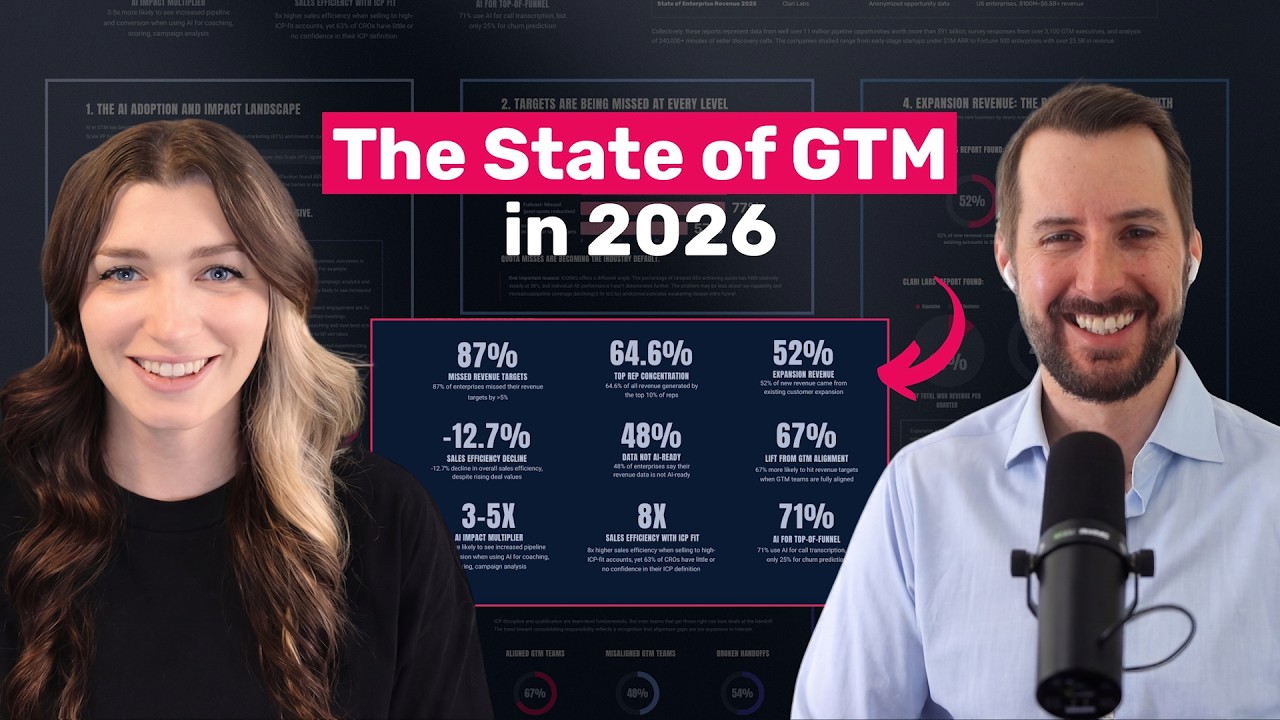
RACHAEL1:31Today we're talking about what's going on with B2B SaaS right now. We recently reviewed seven major state of go to market reports from 2025, and the picture is a little bit sobering. Most companies are missing that number. Sales efficiency is declining even as AI investment goes up. And a lot of people are wondering if SaaS as we know it is in trouble or even dying.
RACHAEL1:52As we've been hearing a lot on LinkedIn. So we're going to dig into what the data says, what Eddy, our CEO and founder, is seeing on the ground and what you can actually do about it to get a better outcome in 2026. Hey, Harry, how's it going? It's going.
EDDIE2:04Well. Great summary. I would add that I think it's not just LinkedIn. I think the entire stock market is talking about this icon of the SAS. Pocalypse. I'm not sure if anybody listening to this podcast if this is new information for them, I doubt it. But I'm kind of excited to jump into this and maybe dispel a little bit of that as well.
EDDIE2:23So yeah, I'm excited to dive into this. There's a lot to unpack here. Seven industry reports, 3100 go to Market leaders, $91 billion in pipeline. I think it was 11 million pipeline opportunities. It's a massive data set that was analyzed by seven of the industry leaders. Actually, more than that, because some of these reports are compiled by multiple groups.
EDDIE2:46And look like we're not we don't have the resources to do that kind of research, which is why we're just stealing from others. What I want to do in this podcast, I want to talk about what's behind it, what we can infer from it will cross and go to market. Leaders should do as a reaction to the data in these reports.
EDDIE3:01And there's a lot of common themes from one report to the next, and I'm really excited to dive into it with you, unpack it and talk about what zeros can actually do with these insights.
RACHAEL3:10It was really interesting to lay these seven reports out side by side and really see the patterns going on that, you know, throughout the entire B2B, SAS industry. So, Adi, what are you hearing these days
RACHAEL3:21just start with people who talk to you every week.
EDDIE3:23Well, let's just start with like objective information, right. Stock market's way down like Salesforce is an example, which I think is kind of like the penultimate example of a SaaS company. I don't know if I want to say they invented SaaS, but they certainly pioneered it. You know, their stock is way, way down. They're actually down for five years.
EDDIE3:43Like, if you had invested it, if you had bought a share of stock in Salesforce five years ago, it would be worth less today than what you paid for it. While the S&P, has rallied, you know, and had great returns, you know, a little bit of ups and downs of course, over the last five years. But like really great returns overall.
EDDIE3:59Which is just absolutely abysmal. Right. And you're seeing this across the entire industry. And I think this is a combination of factors. I think there are legitimate concerns for some of these companies. And this is also just Wall Street doing what Wall Street does. And, you know, I used to work on Wall Street. So I have some level of appreciation, as well as disdain for how they view things.
EDDIE4:21It's herd mentality. And, everybody thinks AI is the future, but, what is AI? What is an AI native company? What is a SaaS company? I think we're really splitting hairs here, trying to define the difference. I mean, Salesforce has tons and tons of AI features. They're talking about rebranding as Agent Force. They've made tons of acquisitions.
EDDIE4:39It's Salesforce, a SaaS. Is it? I, I think we're splitting hairs here. And I don't think that that is really what's necessarily driving the valuation or driving customers to buy Salesforce or really tells us anything about what's happening right now. And so I'll stop there and we can unpack it further as you ask more questions.
RACHAEL4:55So when companies come to you right now, what's the general mood. What's keeping revenue leaders up at night.
EDDIE5:00Well I think like you hit the nail on the head when you summarize these reports then that you know, targets are being missed at every level. You know we're seeing this across the board right. And so when we have zeros and revenue leaders reach out to us, there's oftentimes and it depends on the organization and how open they they are about things.
EDDIE5:19There's definitely folks especially we have some customers that are not in B2B SAS that are crushing it. There's definitely folks that are doing really well. But I think across the board a lot of, go to market teams are struggling, a lot of salespeople are struggling, very few are hitting quota. Quota attainment is down. And these, I think, are all things that most people listening to this podcast are probably well aware of.
EDDIE5:42But then I think, you know, we don't generally have conversations where we stay at this high level for very long. So when we get into the weeds, that may be the more interesting thing to share about what we're seeing. And a lot of it comes down to the fundamentals that we're always talking about. And the thing that I'm seeing, especially with some of, like the podcasts you've been doing recently, Rachel, like you had, Kyle Naughton on the podcast, and he published something the other day on LinkedIn talking about this divide.
EDDIE6:11We are seeing some companies that leverage AI effectively create these massive efficiencies that are driving massive improvements in their ability to generate revenue. And I think part of that is having really smart leaders and really smart rev ops and go to market engineering teams, but it's also this focus on getting the fundamentals right and planning things right, and doing all the things that we need that we knew that we needed to do in go to market all this time.
EDDIE6:41But I think that's now setting a foundation that is being accelerated by AI or not. Because if you don't have that foundation, you layer the AI in there and you save a few minutes here in a few minutes there, but you're not seeing impact on revenue. Meanwhile, your competitor has that foundation in place and they're seeing dramatic improvements in their revenue engine.
EDDIE7:01And you're seeing the separation, the haves and the have nots. And I think that that is probably the bigger theme that goes beyond just the product, though, at the same time, like, let's not ignore the issue here. You can only do so much with your product and your product market fit. I don't think there's any magic bullet and go to market to sell an inferior product.
EDDIE7:23At the level of scale that's expected of most B2B SaaS companies.
RACHAEL7:27And I think there's this really big AI pressure cooker event kind of happening right now. Like you said, there's the haves and the have nots. There's this feeling that like, if you if you're not incorporating AI into what you're doing, you're going to get dusted by competitors because everybody is using AI now. So I think a lot of these companies are implementing AI tools prematurely.
RACHAEL7:47You know, as you said, without having these fundamentals down. And then they start amplifying the wrong things and they're wondering why is their investment not going anywhere with AI? Why is this not working for them? So yeah, let's get into that a little bit more. We did have a part of these reports was from Scale Venture Partners. And we did a whole other podcast and a whole other newsletter specifically on this one report with Craig Rosenberg.
RACHAEL8:13And one of the insights from their research, we thought was very interesting that there's, divide between companies who implement AI differently. So there's this phase one AI implementation versus phase two AI implementation, with phase one being more productivity gains like drafting emails, summarizing calls, and phase two being things that actually move department level metrics like microsecond tation, campaign analysis I call scoring and stuff like that.
RACHAEL8:42And they their data found that companies with phase two AI implementation were 3 to 5 times more likely to see measurable revenue impact from their AI usage, but they found that most companies are still stuck in phase one. So there weren't a ton of companies that are doing that phase two implementation. So, Eddie, what do you think is keeping people stuck in the productivity side of AI?
EDDIE9:07I think it goes back to that foundation. So let's use some concrete examples to paint a picture here. So let's say that we want to do account research. We want to help salespeople do account research using ChatGPT or Claude or Gemini. It's super simple. You just buy everybody licenses and you say, hey, go pop in there, you know, put the website in there and ask it to do account research.
EDDIE9:28So let's take that a step further. Let's go and write a prompt that we can share with everybody. Okay. That takes however long it takes to write a prompt. Not a lot of time. Or we could even take it a step further and let's create, you know, a gym or, you know, any kind of shared prompt that we can share across the team, across whatever tool we're using.
EDDIE9:50And then now it does it for the wrap. All of these things are very, very fast and easy to spin up. And you don't necessarily need any foundation for this. Right. But how good is it to do account research for a wrap and save them all the time in the world to do this account research if they're targeting the wrong accounts to begin with, if they're targeting the wrong people in those accounts, if they don't know the right way to do account research and the right way to translate that into messaging, I mean, what does it do to go and analyze the annual report for a company?
EDDIE10:21If the sales rep has no idea how to translate that into their actual step by step sales process? So I think that's part of it. Right. On the flip side, and I want to dive into Kyle Norton's post the other day that I think really resonated with me. He talked about the sort of this bottoms up versus top down approach of developing AI, and the bottoms Up is kind of what I just described.
EDDIE10:44It's like, let's buy everybody licenses and let reps just start banging away and trying to figure out what's going to help them versus the top down approach, which is as an organization, let's look at this holistically, and let's try to figure out how we can design a system that is going to be better and more efficient for our reps and our marketers and our customer service, our customer success team.
EDDIE11:03And Kyle made a very strong argument for the top down approach and the reason being is he's saying, look like there's just a layer of infrastructure that a single person, especially a rapper or a marketer or a customer success person, can't replicate. Like Rachel, if I come to you and I say all the things that you're doing every day, I need you to, like, pop into Claude and write a prompt.
EDDIE11:26You can do that, but you don't have the time or even the skill set to say, okay, we're going to build this massive database. We're going to connect it with, whichever. I only use, we're going to have a workflow that we're going to build out with Nate, and we're going to, you know, create MCP. We're going to go and use cloud code, like we're going to do all of these things that require heavy lifting from, you know, rev ops or go to market engineering standpoint.
EDDIE11:54Now let's start with the correlation causation. First of all, what team is able to do all of that. That's going to be the team that already has a strong rev ops team in place. Go to market engineering team in place has a strong leader in place. They're already ahead of the curve. So when I say correlation causation, we're comparing companies that already have a lot of like the fundamentals in place and beyond that, that are having this success versus a company that is unable to do that.
EDDIE12:20Let me give another concrete example. So in that report from Scale Venture Partners, they talked about phase two. As an example. They shared for phase two was campaign analysis. Right. How are you going to feed marketing campaigns into an AI to analyze it and then decide which campaigns are going to double down on which ones you're going to cut back on.
EDDIE12:44That requires a really fundamental, understanding of your marketing process. You have to have clear definitions in place. What does an mql mean? How do we define that? How do we measure that? Where's the report that shows us the mql? How about pipeline? Do we all agree on what a sales qualified opportunity is? Where's the report that shows which campaigns, you know, drove the most revenue closed one versus not?
EDDIE13:10If we don't have that stuff in place, we're not going to get a very good result by just popping in and saying, hey, we ran these campaigns. Here's a bunch of mql that we generated. Nobody can agree on the definition. So the number of mql that we generated is meaningless. We have no insight into how those links converted into a pipeline or closed one revenue.
EDDIE13:29And we're just going to take that and dump that in a clod and give it a prompt and say, analyze our campaign performance. What are you going to get out of that? Right. So the teams that have that fundamental the fundamentals in place, meaning they have the definitions all agreed upon, they have the process well documented, and they have a data layer built to feed that AI engine are going to be light years ahead of their competitors, and you're going to have a high correlation between teams that have that and teams that have a really strong CRO integrated in with rev ops and go to market engineering, all working together to go build these things.
EDDIE14:03So how in the world are you going to compete if like Rachel, I just put this on you, all the stuff you're doing every day in marketing, putting this podcast together and I'm like, Rachel, go figure out I and you're all by yourself. Versus a team like Kyle Nortons where everybody's aligned and they have this like massive amount of resources to go build the infrastructure to help you.
EDDIE14:22There's no way you can compete like you're just outgunned.
RACHAEL14:25So what's the solution there? I mean obviously it's much harder to just say you're, it's, it's much harder to just do like phase two AI than it is to, to say it.
EDDIE14:35So you know, this is going to be a shameless plug for our services or for hiring either, you know, firms or individual employees like us, you need to hire the right set of people to first build that foundation. So you go to our go to market efficiency pyramid. We've laid this out. We've laid out the fundamentals. We've laid out the adoption.
EDDIE14:53We've even laid out the optimization. You need to figure out how to get a motion in place that's working. So let's take outbound as an example. If you can't tell me who your ISP is, what the territory is that your reps are covering, what the step by step process is to prospect into those accounts and contacts where your reporting is to measure what's working, what's not, etc., etc., etc. and then you actually have people executing those motions.
EDDIE15:18If you don't have that in place, you can't even do the basics to just run a report and say like, well, what's working, what's not like we're doing outbound into this industry versus that industry, which is working better. This is like barebones basic stuff, right? You get that in place, then you can layer the AI on top and you can start to ask, well, okay, we have a really successful motion of targeting the right people in the right accounts going to the website, reading through everything, doing our research, personalizing the email, personalizing the voice mail, personalizing the LinkedIn DM.
EDDIE15:51How could we use AI to do account research to speed that up? Then you go into the go to market engineering layer and you start to think like, okay, how do we build this infrastructure that's scalable across our entire organization? And I had an moment listening to a podcast the other day, and they were talking about like, one of the biggest problems with AI is like out of the box.
EDDIE16:10It's designed in a silo, like you have your chat and I have my chat and they're not talking to each other. And if we just give everybody licenses in the organization, we're like, have at it. You're not going to get results that are going to move the needle. You're going to get these little efficiency gains where everybody is like, figure it out.
EDDIE16:26I can save ten minutes here in ten minutes here. But we're not seeing that impact revenue versus like we have seen more and more stories recently like Kyle Naughton, like what Craig shared in the Scale Ventures report, where there's actual tangible revenue growth being attributed to the AI agents and AI that people are building and implementing, but it requires the right people at the right time with the right attention to, like, roll their sleeves up and build this foundation and then build on top of that foundation.
RACHAEL16:56you think it's kind of just a natural progression? Then once you have the right team and infrastructure in place, you're just naturally going to find these areas where you can use AI for, you know, stuff that impacts the actual business outcome.
EDDIE17:08Yeah. And I don't think it's any different from what we saw with technology in the past, whether it's Salesforce or Outreach Sales Loft or what we're doing in marketing or what we're doing in customer success, like the teams that have had this, these fundamentals in place have always been able to optimize that. I mean, if you think about what AI is doing is it's pattern matching, right?
EDDIE17:30So especially on the analytics side, which I think is a really exciting aspect of AI, if we feed it the right data, it can look at what we're doing and what's working and what's not. But if we don't have the right data to feed it, it's really difficult to do that. In addition to that, like it's it's taking inputs and trying to produce outputs.
EDDIE17:50And if we can't even define what a good output is for a human to generate, it's going to be really hard to define what a good output is for the AI agent. And I think we're seeing this more and more. I mean, Jason Lumpkin is talking about this incessantly. There's no like easy magic button, you know, plug in, set it and forget it.
EDDIE18:08Plug and play. Like when we build these AI agents, you have to coach them and give them feedback. Again and again and again, just like a human. And if you don't have the foundation in place to do that, you're not going to have success with it. And I'm just blown away at the number of people I've talked to where you're like, how are you using AI?
EDDIE18:26Like, we bought everybody ChatGPT licenses and you're like, that's it. Like, I mean, I get it like we've done the same thing. We bought everybody ChatGPT licenses and cloud licenses and Gemini licenses and all that stuff, like. But you can't just stop there. Yeah. So yeah, that's my answer.
RACHAEL18:44And, you know, it's reflected in these other reports as well. The the report that Corey and Sales Loft put together found that 48% of enterprises doubt that their revenue data is a AI ready and Abston pavilion's report found that 44% of the contacts sellers that the contacts that sellers interact with aren't even recorded in the CRM.
EDDIE19:06Yeah. I mean, so, like, what does that mean? Right? What does it mean that we don't have the right data layer in place? First and foremost, it means that we don't have our definitions and process in place. So for example, if we say like this is what an mql means, this is when in SQL means even this is what close one means.
EDDIE19:22Which sounds crazy to me, but we've seen issues with that to then how are you going to engineer the system to provide that data? Second, like what is the step by step process? So we take like the example of sales qualified opportunity pipeline. Right. Like what does that mean when needs to be in place in order to enter pipeline into into Salesforce?
EDDIE19:42The unfortunate reality is like there's a lot of human effort that goes into that. And so if we don't have our process in place and our sales reps aren't following that, and one rep just every single time they meet somebody, they create an opportunity in Salesforce and the next rep, they wait until they get a verbal before putting it in Salesforce because they don't want to put the work in.
EDDIE20:01We've seen this. I mean, this is a literal example that I've seen so many times. Then when you try to feed that data into the AI, it it can't pattern match because it's missing all the key data. You then go down like field by field and you ask like, what are the important fields? So one of the things that I think is really interesting about AI, and this is a combination of AI and non AI solutions, is just augmenting that data.
EDDIE20:23Right. So if we want to know and you got to think about like what data is relevant to our process. Right. So every organization is selling into something a different offering into a different type of customer. They're like that's what makes your product unique. Well, you can't just say, okay, like we need to see every single company's name, address, revenue and headcount.
EDDIE20:44That's not enough. So where do you want to augment that data? Some of that data needs to be manually entered by the humans that are speaking to that prospect or customer. But to the extent that we can augment that data with tools like zoom info and Clay using AI to, you know, go scrape the website, there's all kinds of use cases.
EDDIE21:02Oh, and I skipped over emails, call transcripts, etc. we can augment a lot of that data, and then we can take our best customers, fill out that data, and then try to reverse engineer who we should be targeting. And it's a really exciting thing, but most organizations aren't there. I mean, I was looking at a customer's org a while back and they had $100,000 sales opportunity.
EDDIE21:30And this isn't just one sales opportunity. This is just the one random one I happen to look at. And they had $100,000 sales opportunity. That was close loss and there was no reason. There's no notes. There's no indication of like who made the decision, what their decision criteria was. None of the metrics stuff. You just look at this and you're like, okay, I know that the rep had a series of meetings and then lost this deal.
EDDIE21:51That's all I can see. If we feed that information to the AI, and then we take the same data for the closed one, which also doesn't tell us anything. What is the AI going to tell us? Absolutely nothing. It's going to be like you have a much higher culture with people named Bob. Cool. Thanks.
RACHAEL22:07Yeah, exactly. Or even worse than that is that, you know, the incorrect data makes the AI find the wrong patterns and feed you back completely wrong insights that you then just take at face value, go to your board or whatever, and then you start making business decisions based on these incorrect insights and just start going in the absolute wrong direction.
EDDIE22:29Well, and this is a really good example, right. So like I'm not sure to what extent people would actually do that because we all know AI hallucinates. But if you think about it like if we don't have the team in place to build out these fundamentals, to drive the team, to adopt those fundamentals, to then like analyze the data and see what's working and what's not, then we probably don't have the organizational rigor to do the things that we need to do to make a AI work, right, because we're going to have to go and build an agent.
EDDIE22:58We're going to have to continue to coach it and iterate upon it. We're gonna have to verify that the outputs are are good. We're going to have to work with it. And Jason Lemkin, they've got all these AI agents that Sastre that he talks about. He emphasizes pretty, pretty strongly that you basically have to coach these AI agents just like a human.
EDDIE23:21If you don't have the team in place to do the basics, how are you going to do that? You're just not I'm sorry. Even people that are well aware of that, like, I know we should do this. I know that the initial output is not good or sufficient. We just don't have the time, resources and expertise to go iterate on this.
EDDIE23:40And I don't think there's going to be any secret sauce here. You just have to keep iterating and iterating and iterating. Yes. Like there's some stuff that's very complicated from a good market engineering perspective that I won't get into on this podcast.
EDDIE23:51But if you don't have the time and resources to iterate on it, you're not going to get to the final destination that these other organizations are getting to.
RACHAEL23:59Absolutely. And to give, you know, our listeners example of what this can look like when done successfully. You know, we talked to Kyle Naughton recently and had him on the podcast and had a row newsletter on him from the podcast. They used a I call scoring to change their close rate. Close one rates from 30, I think it was 35%, 30 to 53, 38% to 53%.
RACHAEL24:24Closed one. And you know, 38% isn't a bad number. It wasn't like anything was broken there. And they were, you know, struggling and underwater, but they were they had the infrastructure in place. They had the tools in place. They had the right data in place. And then they were able to continue to investigate and find out where they could improve even further.
EDDIE24:43Well, and this is what I'm talking about with the correlation causation thing, right?
EDDIE24:47When I read because you did the podcast and you wrote the article, which is really nice, by the way, when I'm reading it as like a passive listener, I'm looking at this and I'm seeing like, okay, they had, a culture and go to market on analyzing their data on a continuous basis and consistently looking for ways to tweak the go to market engine to make it better.
EDDIE25:10That is, you're already in the 1% if you're there, right? So it's not like they woke up one day and said, we want to deploy this AI agent and we have junk data. We can't get anybody to log in to Salesforce. All of our systems are disconnected. Marketing has their Mql report over here, and sales has their closed.
EDDIE25:29One report over here. And CSW is using yet another system. They had all of these fundamentals in place. They had the people in place. They had the practice of analyzing their data in place, which by the way, in our go to market efficiency pyramid, the third layer optimization is primarily just like analyzing your data to see what's working, what's not.
EDDIE25:47Then they layer the AI agent on top and the agent, the AI agent, told them things that they were surprised by. Like Kyle said, you know, I would have thought that the number one behavior correlated with winning deals would have been, doing good discovery. And they found that wasn't the thing that made the big difference. It was 12 other things, like asking for the sale or clarifying next steps, like really simple stuff.
EDDIE26:12And then of course, hindsight is 2020. You look at it, you're like, oh, okay. Like they have a transactional sale where they sell them, five business owners, restaurant owners, to be specific. It's all about momentum. These sales happened really quickly. It's probably an emotional buy for these these individuals. It's not like they're going through a procurement.
EDDIE26:28Right. That makes perfect sense. I wonder what would happen if you ran the same I call scoring on an enterprise selling motion, right. I would think I would think that discovery would show up as much more, you know, key to closing and winning deals. But that insight was invaluable for them. And to your point, I mean, 38% is a phenomenal close rate.
EDDIE26:51Most B2B sales companies right now are looking at close rates between 10 and 20%. And it's not because they can't close deals, it's because their definitions and process are broken. They're closing 10% of deals that many of which that they were never going to close. They were never qualified. It's just people dumping stuff into the CRM. Then on top of that, they're missing steps in the sales process.
EDDIE27:13That's not the case when you have a 38% closure. When you have a 38% closure, you've got stuff dialed in. And to then take that to 53 is incredible.
EDDIE27:22I mean, that's an improvement of what's the math on that. I can't do 53 over 38 in my head. But that's something like that's something like a 30% improvement, 30% more closed one revenue.
RACHAEL27:35That's massive. That's crazy.
EDDIE27:37You know, it's not like 53 -38 is 15 or whatever. It's oh no, that's more than 30%. It's like 40% improvement. That means instead of closing $100 million in revenue on your pipeline, and you're closing $140 million in revenue, that's insane.
EDDIE27:54Quick pause. If you're getting value from this episode, I want to ask you a small favor. Take 30s right now. Open up the app you're listening to this on. You can give us a five star rating. It sounds small, but it's the single biggest thing you can do to help us get conversations like this in front of more revenue leaders.
EDDIE28:08While you're there, hit follow so you never miss an episode. Okay, let's get back into it.
RACHAEL28:13All right, let's move on to ICP discipline. So the forecast report found that high ICP fit accounts are eight times more sales efficient, but the only make up for 23% of the average pipeline and 56% of companies are still defining ICP based on gut feeling. With about 63% of crows having little or no confidence in their ICP definition, which is not good.
RACHAEL28:39Absolutely terrible.
EDDIE28:41Perfect segue. Oh, sorry. Go ahead.
RACHAEL28:44Yeah. I was gonna say, why do you think, first of all, why do you think high ICP fit accounts are eight times more sales efficient?
EDDIE28:50I mean, this is obvious. Like that's the definition of ICP, right? Like that's. Yeah. I can't think of a good analogy here.
EDDIE28:57that's how you define ICP. Like if you ask me, like, hey, how do I how do I define my ICP? I would say, go in and figure out which accounts are eight times more likely to close. That's your ICP, right? It's really that simple. Doing it is the hard part.
EDDIE29:11So this goes back into what we were just talking about. If you don't have the foundation in place, it's going to be really hard to get your ICP defined and then to get your team to actually adhere to that ICP when they're working pipeline. So, for example, let's say we want to look at all of our best customers.
EDDIE29:30We want to look at the deals that we've closed one the largest deals, the fastest sale cycles, the easiest deals to win. And by extension, we want to look at lifetime value. We want to look at retention rates. We want to look at which customers were easiest to serve. That requires a lot of data, especially in the extreme right.
EDDIE29:51Like, let's take this to the absolute extreme. When we say we want to look at our best, most profitable customers, how do we define that? Well, we need to know how much revenue is tied to each customer, how many years they've renewed for okay, that's table stakes. That's pretty basic. We want to know, like how many customer service cases they submitted.
EDDIE30:11We need to understand, you know, their sentiment. If they're happy with us, they're satisfaction levels okay. These are all great things, somewhat easy to get. We have to have like proper systems in place for this. We need to understand like how difficult they are to serve. You know, how is our team bending over backwards and we're losing money to keep this customer?
EDDIE30:30Or are they super easy to serve? Right. That requires a fair amount of data. But then we have to cross-reference that with all of our sales data. Did it take us like 17 meetings and we had to go through procurement. And, you know, we had to, you know, have everything go through legal and red line contracts and all of these, like, hoops that we had to jump through to win this customer.
EDDIE30:47Where do we get that data from them? Right? Then we have to extend that and say, okay, great. Now we know who our best customers are. How do we describe them? We need their thermographic data, their technical graphic data. We need nuances about those customers that dictate how we sell uniquely. Right. And so I've used a couple examples in the past of this.
EDDIE31:07When I was at Salesforce and I was trying to sell, the competitor to HubSpot used to be called Pardot don't even know what it's called these days. That tells you anything about my feeling on the product. You know, we would go to companies websites and see if they had HubSpot, if they had Marketo, if they had a bunch of trackers, if the website was nice and it looked like they spent a lot of money and updated it recently, or if it looks like they didn't spend a lot of money and updated it ten years ago.
EDDIE31:31These are really important factors, right? If you don't have that data set, it becomes hard to identify who your ICP is even when you're looking at them. If all you have is the name of the company and the revenue, then you're like, great! Our best customers are companies in this industry between $1,500 million. Okay, great. Can we be more specific?
EDDIE31:50Because the more specific we can get, the more we can define it on the front end and say, okay, this is the target account list that we're building for our sales team. This is the these are the accounts that we should be marketing to. This is the type of content we should try to develop. And we've seen this firsthand.
EDDIE32:05For us, our most successful customers by all measures, are companies up above 50 million in revenue, up to about 500 million in revenue. We've got some companies that are larger than that, that we've had a lot of success with, but we don't see them as often. And then we have zeros. Not only do we have zeros in place, but we have zeros that really care about this stuff.
EDDIE32:24Zeros I want to listen to a podcast like this. I want to figure out how to like, engineer their go to market to be better. The zeros that just want to, you know, scream, make more sales calls and they want to close every deal and they just want to be like Mr. Sales Hero. Those folks are listening to this podcast.
EDDIE32:39And when we try to pitch what we do and how we help them, it doesn't resonate with them. And that's a really unique data point. It's kind of hard to capture. But I think it's really important that companies think about things like this, because if all we're doing is operating on, you know, industry revenue, headcount, then we don't have the ability to like get laser focused on those accounts that have that, you know, eight x, conversion and close rates.
EDDIE33:03The, that all the other accounts have. So we got to get super specific in that requires a really deep data layer. And that data comes from our marketing engine. It comes from the conversations salespeople are having. It comes from third party tools. I skipped over intent. There's all kinds of signals out there to help us define our ICP, and most organizations don't have that data.
RACHAEL33:25And it's funny, we call like that base layer fundamentals. You know, the core things that every company just should have in place. And you would think that, you know, maybe, maybe this is so common. Like, why do we even need to talk about this? Like, obviously everyone would have this in place, but 63% of zeros have little or no confidence in our ICP definition.
RACHAEL33:44And that's one of the fundamentals. And to get that confidence you need all those other fundamentals in place. So it just doesn't add up.
EDDIE33:52Yeah it's hard right. So think about it like the average hero's in C for 18 months. And then they lose their job at 18 months. So they come in. They hit the ground running. And they're just racing to try to hit this target. And then oftentimes they're out of a job in a year and a half. And we see this when we're trying to propose things.
EDDIE34:08I mean we don't even try to propose this stuff. I don't I don't want to say any more. I'm not sure if we ever did, but no person that we've ever talked to says, like, you know what, I want to pay you guys to come in and spend six months just getting the lay of the land. Why don't you go and define our ICP, define our sales process in the six months?
EDDIE34:26I want a bunch of Google Docs and a PowerPoint presentation. I don't know if McKinsey gets away with that kind of stuff, but nobody's hiring us to do that stuff. No zero has the patience to do that, and that's not even knock on the CRO. Like if you're in C for 18 months, you don't have time to do that.
EDDIE34:41So we're trying to strike a balance. I mean, I'm not saying that zeros are not open to that, but we have to find a way to go define ICP while also going and fixing something yesterday so that reps can make more sales calls. Because as much as I always joke about make more sales calls, make more sales calls, if we're not making sales calls, we're not making sales.
EDDIE34:58So like, you have to have both and you have to have a fine balance. Right. And I think the best way to find that balance is to move quick and try to do, you know, the the MVP if we define our ICP, a little bit better than we did yesterday, then we're in a better position. But I have yet to talk to a CRO that says, yeah, we can spend six months just sitting around defining our ICP.
EDDIE35:21Nobody's in a position to do that. Maybe. Maybe if you're like a, you know, $10 billion company, you can hire McKinsey to do that for you. But nobody I'm talking to, you know, has that that capability.
RACHAEL35:32And a lot of zeros there thereafter. You know the new logos new pipeline generation. But how do we get them to balance. You know how they think about pipeline volume versus pipeline quality.
EDDIE35:44I mean that's a hard one right. So again it goes back into the fundamentals. If we have reps that are focused on chasing deals they can't close, then all these bad things happen. Then I'll probably not go into great depth on. But you know, you just lose a lot of valuable selling time on top of that. You know, you're not giving the right attention to the deals that you can win.
EDDIE36:03So you're going to lose some of those because you're skipping steps. You don't have time for reps to be prospecting. Just lots and lots of bad things happen. The trouble is, it takes time and effort to go re-engineer the sales process and then train the team to go do that. And then think about how I can help you do that.
EDDIE36:19Like Kyle Naughton did this just requires a lot of time. And so this is that delicate balance. Like in entrepreneurship, people talk about working in the business versus working on the business. It's the same idea for cross. Like how much time are you spending, you know, telling reps to make more sales calls and helping them close deals and forecast versus working on improving the go to market engine.
EDDIE36:39And if you're not spending any time on working on the go to market engine, it's just never going to improve, like by definition. And then what what I oftentimes see is the CRO that's doing that, they eventually leave the organization either voluntarily or involuntarily, and a new CRO steps in and they say, hold on a second. I worked at Salesforce or HubSpot or Clary or whatever.
EDDIE37:00And like, this is not how you run go to market. Like, we need to fix this yesterday. And sometimes we are fortunate enough to be the recipients of that phone call. I need some help doing this.
RACHAEL37:11Yeah, well, that's why so many of our best clients are heroes. That just came into a new role because they are crows that know that this stuff is important and they always work on this stuff, and they come in to enroll and they see it's not there. They're like, I need execution help on getting this stuff figured out.
RACHAEL37:26Yeah,
RACHAEL37:27this is a perfect segue into the next section on, this data on missed quotas and revenue loss. So how it all comes together in the end, not annual. Those final revenue reports. So across these reports that we analyzed, the majority of companies are missing their number. The car sales loft report found 87% of enterprises missed by more than 5%.
RACHAEL37:51And that's their revenue targets. The EBITDA Pavilion report found 70% of sellers missed their quota, and the full cast report found that even after quotas were reduced, 77% still missed. So, Eddie, what do you think is going wrong here?
EDDIE38:06I think there's a combination of factors. First, I think a lot of these targets are just unrealistic. Companies are setting targets based on hopes and prayers and not based on bottom up fundamental analysis of like, okay, we need to make this many calls. This is our conversion rate. Historically, this is our close rate. Our average sales cycle and our ASP, etc., etc., etc. we have this many reps and those reps need to onboard all the things we outlined in the annual planning framework.
EDDIE38:31There's definitely a gap there, especially when the CEO and the board are just saying like, okay, that's all great, but we still need to hit this number. Okay, well, you can try, but if it's on an unrealistic number, no amount of planning is going to make up for that. In addition to that, I think it's just really hard.
EDDIE38:49I mean, if you look at, David Spitz published a number of reports recently talking about public SaaS companies and how they have gone from spending 40% of revenue on sales and marketing down to 33% of revenue. So they're doing all this cost cutting coming off of, the growth at all costs, zero interest rate era. Okay, cool.
EDDIE39:10We've cut costs. And yet at the same time, they're generating less revenue per dollar of that remaining budget. So we're spending less money on go to market, and we're generating less revenue for each dollar that we're still spending. And, you know, part of that is going to be the market and products, like I said, go to market is not a magic bullet to sell anything to anybody.
EDDIE39:31In fact, I think it's the opposite. If you have really, really good go to market, you're well aware that you can only sell the right product to the right person, in the right organization, at the right time. And right now there's a lot going on. And everybody wants to implement AI across their entire organization. And if you are and a company that is deemed as having a tool that's not AI native or whatever, then there's just a lot less demand for that solution.
EDDIE40:02And it's tough right now. And I think there's a lot of hype. I think there's a lot of FOMO. I think people are buying a lot of AI solutions that are going to do absolutely nothing for them, because there's just tons of pressure to just scramble and buy stuff. I mean, I feel this pressure I get on the phone with private equity and venture capital firms every day and they're like, what are you guys doing in AI?
EDDIE40:22What are you guys doing? An AI, what are you guys doing in AI? It's impossible to ignore that pressure. Every Chro is hearing that. And, you know, I've, I've been in conferences where people are saying, okay, like if you're a CRO or revenue leader, raise your hand. If you're using AI, every single hand in the room goes up and then keep your hand up.
EDDIE40:43If you're seeing revenue impact from those AI solutions and everybody's saying goes down. And so, you know, that's what I'm seeing right now.
RACHAEL40:50And that ties back to, you know, what we were saying in the beginning about phase one and phase two. I, like everyone is using it, but most people are using it for productivity style initiatives. And you don't see like a direct ROI correlation between that. Maybe there is like absolutely, you know, saving time saves money, but it's hard to see the ROI from that.
EDDIE41:09But keep in mind, like even I'm getting confused on what we're talking about here, because on the one hand we're talking about go to market and on the other hand, we're talking about all business, right? Because these go to market teams are selling solutions into other areas in other businesses. Right. And so we're seeing the same thing in B2B go to market that we're seeing across, you know, business in general.
EDDIE41:31I mean, there's all these publications coming out talking about how, you know, everybody's buying AI in every industry, in every department and not seeing any real results. It's the same thing. And so if you are running a B2B SaaS company in your CRO or other, you know, in another way, sorry, another revenue leader and go to market and you're trying to drive revenue for your B2B SaaS solution.
EDDIE41:56You're selling into the accounting department and in health care, you're competing with the pressure that that accounting department and a hospital is facing from their executives and their board and their investors, saying, you guys need to go find ways to implement AI. And what we're also seeing that I think is really interesting is you have a lot of these quote unquote AI native solutions that are just crushing the world, and they're going from like 0 to 500 million in revenue in a year or two, which is just insane.
EDDIE42:25And I'm literally like on zoom calls, talking with their venture capital firms. And they're saying these guys, their go to market is super messed up. They just have tons of demand for their product. Jason Lim can also talk about this. Some of these products are so hot right now that the team can't even respond to leads. So they've just got this flood of leads coming in and they're just ignoring people.
EDDIE42:50And part of it is because it's like, look like we don't have the capability to go hire 100 or 1000 people. So we're going to use automation and AI. And our own go to market to try to respond to these leads. And this is not a best practice. This is not something that like a B2B SaaS company without that level of demand can replicate.
EDDIE43:09It's like, hey, this is not great, but it's the best that we can do. We just have this flood of demand. And then you look at these organizations, you're like, oh my God, they grew to $300 million in revenue in one year. Like we should replicate what they're doing. And it's like, sure, from a product development standpoint. Yeah.
EDDIE43:24From a go to market standpoint, no.
RACHAEL43:26Yeah. That is such an important distinction to make.
RACHAEL43:29So another data point here. Clary labs found that 26% of a company's revenue is lost to revenue week. And that adds up to $2 trillion in lost economic value annually.
RACHAEL43:40So it's a bit of a bit of a change gears here. But, Eddie. Do you think companies are even aware of how much they're leaking?
EDDIE43:47No, because like, you'd have to define it to, to see it. Right. So, when you think about revenue leakage, like let's think about common examples of that leads not getting followed up with, okay, why would you not follow up with leads? What the reason is because you don't have a process in place to track and measure it, or you're just sending a bunch of junk leads to sales, right?
EDDIE44:11There's a bunch of reasons why this is happening. And if you are in that Bo, you're also not measuring it accurately. So you wouldn't even know how much you're losing. If you did know, you'd probably fix it. It's kind of like, I don't know why I'm thinking about, like, a dieting analogy. It's like, if you want if anybody wants to lose weight, the easiest, I shouldn't say easiest, but the, the most successful strategy is just to simply measure everything you're eating, right?
EDDIE44:38If you just know how many calories you're supposed to eat and you start measuring it every day, you'll end up eating the right amount of calories. But what happens is most people, myself included, have no idea what they're eating. Even me, I measure my food, like, every single day. Or sometimes my wife is kind enough to do it for me.
EDDIE44:56And so I can't necessarily eyeball it. It's exactly it's the exact same scenario I'm talking about here, right? If you measure all of your food, you're going to eat less. If you measure all of your leads that aren't getting followed up with, you're going to follow up with those leads. The same thing happens with pipeline, with customer success, with our onboarding customers, with how we are doing QBR and trying to expand accounts and try to save accounts before they're churning.
EDDIE45:22If we don't have the fundamentals in place, we also don't have the ability to measure it accurately.
RACHAEL45:26So how can we and I'm know we've touched on this a bit before, but just in terms of specifically this, how can we get more visibility into potential revenue leaks?
EDDIE45:37I think you just got to get your fundamentals in place. The definitions, the process you build out reports, and then you create a management cadence where you review those reports on a regular basis. Then by extension, since we're here spending so much time talking about AI, then you figure out how to use AI to do that, to streamline that so that you can do more in less time.
EDDIE45:56But like I'm always using this example because I lived and breathed it at Salesforce for three years. It's just so simple. There were maybe 3 or 4 things that they expected us to have just absolutely dialed in on our qualified sales pipeline, and if it wasn't dialed in at any point in time, on any given day, you would get called out for it.
EDDIE46:15And this might sound micromanaging, but in fact, it wasn't. It was just like, really basic stuff. And when you get called out on something like that, especially like from, you know, your boss's boss, his boss's boss, once or twice, you don't make that same mistake again, especially when it's consistent feedback. It's like how the dollar amount, the close date, the stage and the next steps update it.
EDDIE46:36I mean, that's really basic stuff, right? And so if you're just constantly being held accountable to that, you're not going to make that same mistake. But if you don't have that kind of practice in place, no amount of like Salesforce Architecture is going to fix that problem. And yes, I'm all for let's go and scrape through the emails and the call transcripts and let's try to update things.
EDDIE47:00But at the end of the day, the sales rep is the only one that can say this deal should or should not be in pipeline. This deal should or should not be in this stage. I don't think I is yet at a point that we can trust it to just move deals through the pipeline. It can augment that data and say, I think that the decision maker is this person.
EDDIE47:16I think their decision criteria. Is this based on the call transcript? All of that's super helpful. Even without AI, like we've been automating our own sales process and sales processes for customers to limit the amount of like manual data entry that goes into things like the pipeline in Salesforce. But you still have to have a rep, like put that effort in to say, like, these are the deals that should be in pipeline.
EDDIE47:39If you don't have that, then not that your data analysis is going to be flawed and you're not going to have the foundation in place to use AI effectively.
RACHAEL47:46So when we're looking at all these companies, you know, missing their end of year revenue targets, how much of that do you think? You know could be lessened or could be attributed to this revenue leakage?
EDDIE47:57Great question. I don't know what percentage or what number, but I would just say a lot. Right. I think it's going to depend on the organization, like I said, like the organizations that have things really dialed in specifically, they not only have all the process and metrics and reports in place, the adoption, etc., but they also had a really well thought out annual plan.
EDDIE48:19They did a bottom up approach. They figured out like the headcount capacity onboarding, you know, the activities, the conversion rates of those activities, et cetera, etc., etc. those organizations are by definition going to have a lot less revenue leakage, and they're also going to have much more realistic targets when we look at the, you know, the the flip side of this, organizations that have unrealistic targets are also most likely going to have more revenue leakage.
RACHAEL48:45All right. Now let's look a little bit at expansion. Because this is an area where, you know, a lot of revenue can and does potentially come in, but people don't invest in it as much as they should be. So Epstein Pavilion's report found that 52% of new revenue came from existing accounts from their data set. Expansion deals closed in almost half the time, and win rates were more than double new logos.
RACHAEL49:11It also took significantly less stakeholders, involved to close the deals. But Iconix Data found that only 25% of companies are using AI for these post-sale, use cases. You know, like churn prediction or helping with expansion. So, you know, why are people investing in post-sale more specifically with AI?
EDDIE49:35Great question. And I would say, I think Scale Ventures report that we did the podcast on also aligns with that. They said that the the majority or more organizations are using AI more in marketing, then less in sales, and then less than that in CSS. And everything that you say aligns with what I'm seeing. You know, they announced some of those stats at, the CRO conference that pavilion did here in Denver.
EDDIE50:02I've also just seen this my entire career. Like, it's pretty obvious to anybody who's ever tried to sell into new business and existing accounts that it's just way easier to sell existing accounts, and you get bigger deals and they convert faster. There's just trust established. Yeah, like it's just obvious. But I think one of the biggest problems with customer success is a it's sometimes seen as a cost center.
EDDIE50:27They don't get the same love and attention. Many crows don't oversee customer success. If there's no sales leader overseeing customer success, then it's even more likely to be seen as a cost center and neglected. It's oftentimes understaffed, etc. etc., etc. that's one problem. Another problem is it's just way more complicated. Like we've written content on every area of go to market, and every time we come to customer success and you think, like, here are all the things you need to do to find the process, there's way more steps involved, right?
EDDIE50:59Like outbound. Okay. You figure out at a prospect, you reach out to them 10 or 15 times, then you set up a meeting and then it converts to a pipeline. And then you either win the deal or you lose it. And there's some steps in between. Customer success is way more complicated than that. You have to have a proper hand-off from sales to onboarding.
EDDIE51:15You then have to go through an onboarding or implementation process. You have to get them to a healthy point. Hopefully, if they're not healthy, then the Customer Success manager needs to step in and hold their hand until they are healthy. If they get healthy and then become unhealthy, you have to have a process for that. You have to carry them along all the way through the renewal.
EDDIE51:32You have to reach out. You know about the renewal way in advance. You have to make sure that they're healthy, you know, throughout the year. If you haven't done that, by the time the renewal is coming up, it's too late to do anything about it. And then all of that. We haven't even talked about expansion. Right. And you can't expand an unhealthy account.
EDDIE51:48I mean, theoretically you can, but it's really hard to do. So when I worked at Salesforce, covering existing accounts is the first thing I always did. We had all these fundamentals in place. All this data didn't have I because I was there like 100 years ago. But at this point I'm getting old. But I did have the ability to just triage my accounts and say, okay, these are the unhealthy accounts and these are the healthy accounts for the unhealthy accounts.
EDDIE52:11All I was trying to do was just go and kick the door in and say, hey, you know, Mr. Miss, CEO, CRO, CMO, you guys are spending a lot of money with us and it seems like you're not leveraging the tool properly. Can I get you some help and then hand them off to the appropriate party to help them out?
EDDIE52:26That's all that I could do as a caring rep. Then I just focus on the green accounts. How do I expand this account? And you have to have all those things in place before you can really do that effectively. If you have a completely broken, customer success process, then basically you hiring a country manager and you say, hey, let go and call into these accounts and then like trying to figure out, like, which accounts do I call, is this healthy?
EDDIE52:51Is this unhealthy? Like, what do I do? How do I, like, get this handoff? Like, how do I bring in the CSM? How do I get help? Am I carrying, am I there to help? What am I doing? Like? It's a lot of complexity and ambiguity. And if the team is also understaffed, then it just makes things incredibly difficult.
RACHAEL53:08What are some I use cases that you know of or that you've seen that can help with some of this stuff.
EDDIE53:13So I think first of all is just, you know, trying to understand which accounts are healthy and unhealthy, right? I mean, you can definitely do that without AI. But there's some really interesting use cases to use AI to analyze all the different signals that you have. And you think about it. What I think is really interesting is you have your product usage data, which already, by the way, is like hard enough to like take that data, put it into like Salesforce or whatever other tool you're going to use it, analyze it, sum it up, no score, etc. but then you also have all these, all these other data sets.
EDDIE53:42You have the interaction that that company is having with your marketing. If you're doing any, you know, customer marketing, you have third party intent signals. You have all of this data like you might have a stakeholder leave the organization. And that could be a serious risk depending on what your product or service is. So if you take all that data and feed it into AI, there's some pretty incredible opportunities to get a better, better visibility into which accounts are healthy and not healthy.
EDDIE54:07You can have an account that's healthy today and unhealthy tomorrow, right? Doing research like prepping for covers or any other customer interactions, you have a way larger data set, right? So you have all the things that I mentioned. Plus you have all the emails that have ever been set. You have all the, call transcripts, the notes, etc., etc. the product usage that I mentioned, you have a very large data set to inform how you go into that meeting and how you prep for that meeting.
EDDIE54:35So I think that that's a really, really great use case for AI. Obviously any type of like customer service, there's great use cases for it. You have chat bots and things like that that we've had for a long time. Those are the things that come top of mind for me, but I think there's just tons of use cases.
EDDIE54:57You know, there's obviously like writing the emails or writing the draft for the email, like, think about an expansion opportunity, all the data that I mentioned, how do you take that data and then convert that into a sales message? Dear Mr. Miss CRO or CMO or CFO, here's everything that we've learned about your company over the last five years of working with you, summarized in a couple quick points.
EDDIE55:19Here's why I think that you and I should meet.
EDDIE55:21That's an incredible use case for AI.
RACHAEL55:23but to do that you have to remember you need that data to be able to use it. So you got to have the systems in place where, you know, the systems and processes, where your CSM and your people working. These accounts are able to, check these accounts and put that data in somewhere.
EDDIE55:38And you have to have the process in place. Like is our process that we do a QBR with every single customer every quarter. Okay. Well then we can ask how do we use AI to improve that. But if we don't even have that defined, it's going to be a lot harder to figure out how to leverage AI correctly.
RACHAEL55:55So just be conscious of time. Let's quickly go over our last excuse me, insight.
RACHAEL56:02So this is all about handoffs and go to market alignment. So Crossbeam and Pavilions report found that good align to go to market teams are 67% more likely to hit their targets and report 38% shorter sales cycles. But the Epstein Pavilion report found that 54% of teams still lack functional handoffs between marketing and sales. So, Eddy, why do you think this is why our teams so misaligned, even though the the benefits are so obvious?
EDDIE56:32Well, that misalignment goes back into the fundamentals and the amount of effort it takes to put those fundamentals into place. Right? So one of those fundamentals is ICP definition. We talked about how much effort it takes to really dial your ICP in. The next is like think about handoffs from marketing to sales. Like we're going to send an mql to a sales rep.
EDDIE56:50We have to define what is an mql. How are Mql routed? What is the expectation for response times? Do we need to respond within an hour? Within ten minutes? What's the process to do that? How many times do we follow up? These are all necessary in order to have a proper handoff. What information needs to be there with the mql in order for the rep to follow up?
EDDIE57:11Right? How is that handed off from the SDR to the Ehi? What is the expectation? How is are things handed off from sales to customer success? Like literally? I mean, this is something that like we've done in our own organization when we sign a contract, how are things handed off from the person closing the deal? Oftentimes that to me, to Jerry and the delivery team that's going to go deliver on that.
EDDIE57:35I mean, we've sat down and mapped out step by step. We've created automated emails. We have you know, notes in a in a shared place. We schedule an internal, you know, debrief and then we the external kickoff call where I or the sales rep would join to just make sure that we have a smooth transition. And all of that is literally sitting in a Google doc somewhere that says, this is our step by step process to do handoff from sales to CSS, or in our case, delivery or consulting.
EDDIE58:04All those fundamentals have to be in place in order to ensure that you have proper team alignment and handoffs. In addition to that, the reporting engine. So how are you going to have alignment if marketing is judged on Mql and they have their report sitting in HubSpot and sales is judged on solely on closed one, and they have their report sitting in Salesforce, and those reports don't even show the same number of skills.
EDDIE58:25You're going to have pretty serious misalignment if you have that. And then we could go all the way to like, okay, who runs marketing and sales and CSS and how are they incentivized and what are the goals. And I just saw this post the other day, and I can't believe we're still talking about this. And they're saying, yeah, you know, marketing is misaligned because marketing is being judged by how many mql they generate.
EDDIE58:42And it's okay. Yeah. You guaranteed to have misalignment if that's how you are judging and paying, and even giving job security to the person running marketing.
RACHAEL58:51Absolutely. It's so easy to just get mql. It's like if you told me, hey Rachel, I just, I need you to get, you know, a thousand mql or something. Any, any way possible. There are ways that I could go out there and try to do that, but probably none of them would be any one that we would actually sell to.
EDDIE59:07Yeah. So I didn't ask you to do that.
RACHAEL59:10Yeah. All right. So we covered a lot of insights, a lot of data so far in this podcast. Eddie, what's a common mistake that you see companies making when they're trying to respond to all of this pressure that they're experiencing in business right now?
EDDIE59:25Well, we've talked about this a lot. I think it's just trying to do everything at once. I'm trying to do too many things at once.
EDDIE59:30My advice to somebody trying to implement I would be the same advice I would give to somebody trying to do anything and go to market, which is center in on the thing that's going to drive the most improvement.
EDDIE59:43Start with is it new business or is it net revenue retention? Is it generating more pipeline or closing more of the pipeline or generating? Is it a retention or expansion? Is it outbound or is it inbound or is it all bound or is it partners? Is it the handoff from sales, the onboarding process? Is it the actual renewal process?
EDDIE60:02Is it how we generate pipeline for expansion opportunities? Is it how we, you know, manage our pipeline opportunities and expansion and close those deals? What is it which of those things just pick one thing that, if improved, would have the most outsize impact on your organization and you might not have the perfect answer for this. You might have to take a guess, but just answering that question will put you light years ahead of everyone else.
EDDIE60:25And then you could say, okay, what fundamentals do I have to have in place? What do I need to do to drive the team to adopt those fundamentals and actually execute? How can we optimize that? By analyzing data and seeing what's working, what's not. And then how do we layer AI on top of that? And if you pick a narrow enough thing, you can actually do that very, very fast.
EDDIE60:44You can go to our go to market efficiency pyramid. And you can literally see like item by item, all the things that need to be done. And oftentimes in a narrow enough use case, you can do all of that in 90 days. Or maybe not all of it, but a lot of it. And then now you build your your MVP for your AI agent, and it's off and running because you've defined what good looks like.
EDDIE61:04And then you can start to iterate on that. And then my advice would be don't move on to the next thing until you get that right. It doesn't need to be perfect. You don't have to like, dial this in and say, okay, like our AI agent for outbound or inbound, Susan Ma, because it's maybe a better use case.
EDDIE61:18We've got an AI agent that's responding to inbound leads, and now we have a 90% conversion and and, 75% close rate. And our average deal is now $500 million. We have to have all that in place before we go and try the next thing. No, but it just needs to be, like, not an absolute dumpster fire.
EDDIE61:36Like, okay, like we're responding to all of these leads and we've got a decent conversion rate, and, like, this seems to be working okay. We can keep tweaking this and iterating on it, but we can also move on to the next thing once we have that in place. But I see so many organizations where they're trying to do 15 different things and you're like, you can't even get your reps to follow up the inbound leads that you have.
EDDIE61:54Like if you have literally a person that goes your website and says, I'd like a demo and they don't hear back for, you know, 15 days, okay. I mean, I had Duane default on the show and he shared this exact example. They're like one of their major inbound channels was people registering for trials. And if I remember correctly, I think he said it took them ten days to respond to an inbound lead.
EDDIE62:16Somebody is literally going and saying, I would like a trial of your product, and they don't hear back for ten days. That's by which point.
RACHAEL62:23Pretty.
EDDIE62:23Bad, by which point they've already bought from the competition. So he went in to fix that. And you can imagine the night and day results that you would see from doing something like that. And then he talked about it in our podcast about how after like kind of getting those fundamentals in place now they're able to start layer on AI agents.
EDDIE62:41So that would be my advice.
RACHAEL62:42And by the time this podcast is out, we are going to have to go to Market Ops Diagnostic Framework released, and we'll have a link to that in the show notes. I won't get too deep into the weeds on what the diagnostic will tell you, but it'll be very helpful tool and doing all this yourself, and includes a worksheet where you can plug in your answers and see a visual heat map of where you should be prioritizing, your efforts and your time.
EDDIE63:06Yeah, it's just translating our go to market efficiency pyramid and a couple other things to just kind of narrow in and say, like, you know, here's step by step how you diagnose your go to market engine. So it's not necessarily any like radical change from the content that we've been putting out, but we've packaged it in a way to make it easier for people to actually go run a diagnostic on their go to market in the way that we do for our customers.
RACHAEL63:25All right, Eddie, to send us off on the last question here, what gives you optimism about where B2B SaaS is headed.
EDDIE63:31Ooh what what a good question. I posted this like a week or two ago.
EDDIE63:37I started this company because I was inspired by what I saw at Salesforce and with some of our best customers. I've been in sales my whole career. I paid my way through college in sales. I even did some sales before I started college.
EDDIE63:52Every experience I've had, with the exception of Salesforce, has involved me walking in the door and just stepping into this just absolute mess where I'm spending all this time and effort trying to clean things up instead of actually selling. So I started this company and I said, like, I want to go and implement all these fancy tools and all these processes and do all these wonderful things for companies.
EDDIE64:15And I became disenfranchized really quickly, specifically with like sales left and outreach, where I just saw like, okay, we've implement this tool just so we can use it as a spam cannon and have a race to the bottom to get like virtually zero response rates, because we don't have this like fundamental strategy and process in place. So we pivoted and we said, okay, we're not just going to build our tools, we're going to make sure that that strategy and processes in place.
EDDIE64:38And we've been pitching this to the world and it's been great. We've got some amazing customers, and we're working directly with crows and CEOs and private equity and venture capital firms backing them. And it's really wonderful. But it's really hard because like, I feel like we are preaching this to the world and so many people, it just doesn't resonate with them.
EDDIE64:57They're just not ready to embrace this concept of building a data driven, process driven, strategy driven, go to market organization. There's still a lot of well, to hire more salespeople. Let's make more sales calls. Let's close deals. And, you know, sure, there's a spectrum here like nobody's on either extreme end of the spectrum, but there's just a lot of resistance to this.
EDDIE65:17It's like, I don't have time to build a better go to market engine. I just need to hit this target. That's unrealistic that we couldn't have to begin with. What I'm seeing is that there is going to be a separation. The camp that is not going to embrace this stuff is going to die out. It'll just be impossible to compete.
EDDIE65:35And lately I've been using this analogy to farming. My grandfather farmed like 40 acres and a mule with the mule. Right. And I think it was like 100 acres. And you probably had a tractor. This is like a hundred years ago. I don't know, but there's a very small farm today, you see, like a single farmer, like one guy with nobody helping him.
EDDIE65:51Or maybe some, like, temporary, people farming, like 17,000 acres. And then on a per acre basis, the output is like five x. So it's like an 850 x output per person in farming. This is why, like, we've gone from a society where 90% of people work in farming to like 1%, and you cannot farm with 40 acres and a mule anymore, like you will literally starve to death and, you know, be, you know, out there like asking for government assistance to, to to feed yourself.
EDDIE66:21It's just impossible. I think that we're going to see the same thing happen and go to market. I think that the organizations that do not embrace this change are either going to die out or they go to market. Leaders in those organizations are going to leave, and new people are going to come in and they're going to say, we have to have this stuff in place, because once we implement AI, it's either going to work or not work based on whether or not we have that foundation.
EDDIE66:46And if it doesn't work, we will not be able to stay in business. We will not be able to outcompete our our competition because they are just going to be so much better, so much faster.
RACHAEL66:56And on that note, that is all we have for the podcast today.
EDDIE67:00Awesome. Thanks for putting this together.
RACHAEL67:02Thank you so much, Eddie.
EDDIE67:05Thanks for listening to the episode. If this resonated. Please give us a five star rating and a follow. It helps us reach more people, and you get our latest and greatest content without having to search for it. And if you're looking for hands on help and go to market strategy and or rev ops, please reach out to us.
EDDIE67:19We help our clients with everything from annual planning to improving processes and go to market, implementing systems to support those processes and go to market AI. We're always happy to offer a free consultation to help you identify the best opportunities to improve your go to market engine, with or without our help. You can find us at Union Square consulting.com and the info will be in our show notes.